

For most buyers, recycled plastics (rPET) and recycled metals offer the best mix of low impact and durability, while bio-acetate is the strongest plant-based option when a brand backs it with real certification. The trade-off is simple: tougher materials tend to outlast biodegradable ones, and a frame that breaks in a year is never the greener choice. Read on before you shop by buzzword.
TL;DR:
- Recycled metals and GRS-certified rPET offer the best combination of low environmental impact and long-lasting durability.
- Bio-acetate is a genuine plant-based option that requires industrial composting facilities to break down, which most municipalities lack.
- Impact-resistant materials like recycled metal and TR90 are ideal for frequent travelers, active use, or long-term wear to maximize lifespan.
- Certification labels like GRS, FSC, ISCC, and OEKO-TEX provide verified transparency, while vague eco claims are often untrustworthy.
- Longevity, repairability, and design features such as screw hinges and replaceable lenses are more environmentally beneficial than just choosing biodegradable materials.
Table of Contents
- Eco friendly sunglasses materials compared
- What lens specs actually protect your eyes?
- Which certifications actually mean something?
- Why longevity beats biodegradability
- How do you choose the right material for your needs?
- How foldable design fits the sustainability picture
- Balancing values and practicality when you buy
- How ROAV Eyewear fits the sustainability checklist
- Sources
- FAQ
Eco friendly sunglasses materials compared
Sustainable eyewear materials fall into a few clear categories, and each one comes with a real trade-off, not a marketing slogan. Here’s what you’re actually choosing between when you shop for eco-friendly optical frames or sunglasses.
Bio-acetate is a plant-derived version of standard cellulose acetate, often made with cotton or wood pulp plasticizers instead of petroleum ones. It gives frames that glossy, layered tortoiseshell look people associate with premium eyewear, and it’s a genuine step-down in fossil fuel use. The catch is that bio-acetate needs industrial composting facilities to actually break down, and most municipalities don’t have that infrastructure. Tossing it in a backyard compost bin does nothing.
Recycled plastics and rPET divert post-consumer waste like water bottles into frame material, and GRS-certified versions hold up to impact about as well as virgin plastic. Big suppliers have pushed this further with branded resins like Eastman’s Acetate Renew and Tritan™ Renew, along with Econyl®, a regenerated nylon made partly from fishing nets and carpet waste, which now shows up across mainstream eyewear collections.
Recycled metals, mainly aluminium and steel, cut carbon intensity significantly compared to mining and refining primary metal, and a well-engineered recycled-metal frame lasts for years without warping or corroding. They’re also a solid pick for anyone with sensitive skin, since metal alloys tend to produce less off-gassing than certain plastics.
Nylon and TR90 are technically petroleum-based, but they’re worth including because of what they do for durability. TR90 is nearly unbreakable, flexes rather than snaps, and stays light. It’s not “green” by material origin, but a TR90 frame that survives a decade of travel has a smaller lifetime footprint than a fragile alternative replaced three times.
Bamboo, wood, and cork look and feel the most “natural,” but treat the labelling with some skepticism. Most bamboo and wood frames rely on resins and laminates to hold their shape, and those binders can reduce biodegradability and off-gas volatile compounds. Cork performs a little better structurally but still usually gets bonded to a plastic or metal core for hinge strength.
Quick suitability notes:
- Travel and active use: recycled metal or TR90 for impact resistance.
- Sensitive skin: bio-acetate or recycled metal, both lower in VOC off-gassing.
- Occasional or fashion wear: bio-acetate for the premium finish.
- Budget-conscious eco shoppers: GRS-certified rPET for the best cost-to-impact ratio.
What lens specs actually protect your eyes?
Frame material gets most of the attention, but lens safety is a separate question, and it’s not one to compromise on for the sake of sustainability. Look for UV400 on the label, which means the lens blocks essentially the full UVA and UVB spectrum. The American Academy of Ophthalmology recommends sunglasses that block 99 to 100% of UVA and UVB rays, and the CDC treats UV exposure as a genuine public health concern, not a cosmetic afterthought.
Common lens materials include polycarbonate (light, impact-resistant, standard for sport use), CR-39 (sharper optics, heavier, less impact-resistant), and mineral glass (best clarity, but heavier and prone to shattering on hard impact). On the sustainability side, some brands now use advanced polymers like TROGAMID® myCX eCO, which suppliers position as a lower-carbon lens option without sacrificing optical clarity.
Polarization cuts glare off water and pavement, which matters for driving and water sports. For travel, prioritize scratch-resistant coatings over anything else. A scratched lens gets replaced fast, and a fast replacement cycle undoes whatever sustainability gains the frame material offered.
Which certifications actually mean something?
Not every green label on a hangtag deserves your trust. A handful of certifications carry real third-party verification, and the rest is often marketing copy with no audit behind it.
GRS (Global Recycled Standard) verifies the actual recycled content percentage in a material and checks the supply chain that produced it. FSC (Forest Stewardship Council) applies to wood and bamboo components, confirming responsible forestry sourcing. ISCC, including ISCC mass balance, tracks bio-based and circular feedstocks through complex supply chains. OEKO-TEX screens for harmful substances in the finished product. B Corp certifies the company’s overall social and environmental practices, not a specific material.
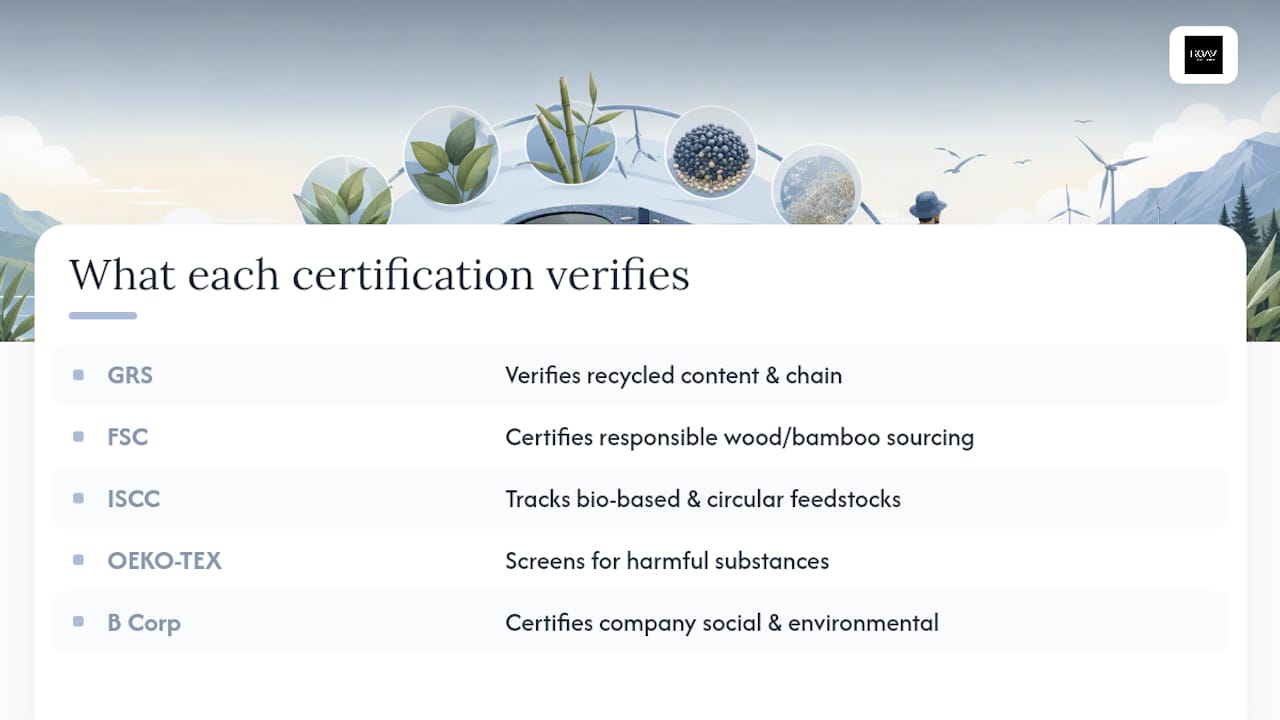
As one eyewear sustainability review puts it, shoppers should move past vague “eco-friendly” language toward material transparency and verified certification. If a product page says “eco-conscious” with no percentage, no certification logo, and no explanation of what that means, treat it as a red flag.
Why longevity beats biodegradability
A frame that biodegrades in five years but breaks in six months isn’t actually the lower-impact choice. Lifecycle research on eyewear shows that raw material sourcing is only one slice of the footprint; manufacturing, shipping, and end-of-life handling typically push total emissions for a single pair somewhere in the 1 to 2 kilogram CO₂e range, and that number multiplies every time a broken pair gets replaced.
This is where design matters as much as material choice. Look for:
- Removable, replaceable lenses so scratched or damaged lenses don’t force a full frame replacement.
- Separable, screw-based hinges rather than glued joints, since glued components block proper recycling at end of life.
- A stated repair or take-back program, which signals the brand expects its product to last long enough to need one.
Take-back schemes work by collecting worn-out frames for material recovery or refurbishment rather than landfill disposal, though coverage varies a lot by brand and region, so check the specific terms before assuming a pair qualifies.
Pro Tip: Before buying, search the brand’s site for the word “repair.” If there’s no repair policy or replacement parts program listed anywhere, assume the frame is designed to be replaced, not fixed.
How do you choose the right material for your needs?
Match the material to how you’ll actually use the sunglasses, not to which one sounds greenest on a product page.
- Frequent travellers and hikers: recycled metal or TR90 for impact resistance and weight.
- Sensitive skin or allergy concerns: bio-acetate or recycled metal, both lower in VOC off-gassing.
- Everyday fashion wear: bio-acetate for the finish, provided the brand discloses composting requirements.
- Budget-conscious sustainability shoppers: GRS-certified rPET for the strongest value per dollar of impact reduction.
- Repair-minded buyers: anything with screw hinges and swappable lenses, regardless of base material.
Before handing over your money, ask the brand five direct questions: What percentage of this frame is recycled or bio-based? What third-party certification backs that number? Is there a repair or replacement-parts policy? What’s the lens’s UV rating? And is there a take-back or recycling program at end of life? A brand that can’t answer at least three of those clearly is likely leaning on vague language rather than verified practice.
Price and warranty length are decent proxies for durability, too. A frame backed by a multi-year warranty is a frame the brand expects to survive years of use, and that expectation usually holds up.
How foldable design fits the sustainability picture
Material choice is one half of the sustainability equation. Design is the other half, and it’s the half most buying guides skip. ROAV Eyewear built its frames around a patented micro hinge that lets sunglasses fold down to a compact size without the screwless construction sacrificing structural strength.

That matters for longevity. A frame that folds flat and travels in a hard-shell pouch is a frame less likely to get crushed in a bag, scratched against keys, or left behind and replaced. Many foldable designs feature UV400-rated, polarized lenses, so durability upgrades need not come at the expense of eye protection. A durable, foldable design that survives years of travel does more for lifetime footprint than almost any single material swap.
Balancing values and practicality when you buy
The conventional advice to “buy biodegradable” oversimplifies a genuinely complicated problem. A frame that breaks down in a landfill within a decade but shatters within a year of ownership has done more environmental damage through repeated manufacturing and shipping than a durable recycled-metal pair that lasts fifteen years and never breaks down at all. Prioritize material transparency and structural durability first, then look at what happens to the frame at the end of its life. Repair it when you can, and choose brands that make repair and take-back genuinely possible.
— Thomas
How ROAV Eyewear fits the sustainability checklist
If durability, repairability, and verified material choices are what you’re shopping for, ROAV Eyewear’s foldable collection is built around exactly that checklist. Some foldable frames combine screwless, micro-hinge construction designed to resist wear, along with UV400-rated polarized lenses that meet recommended protection standards.
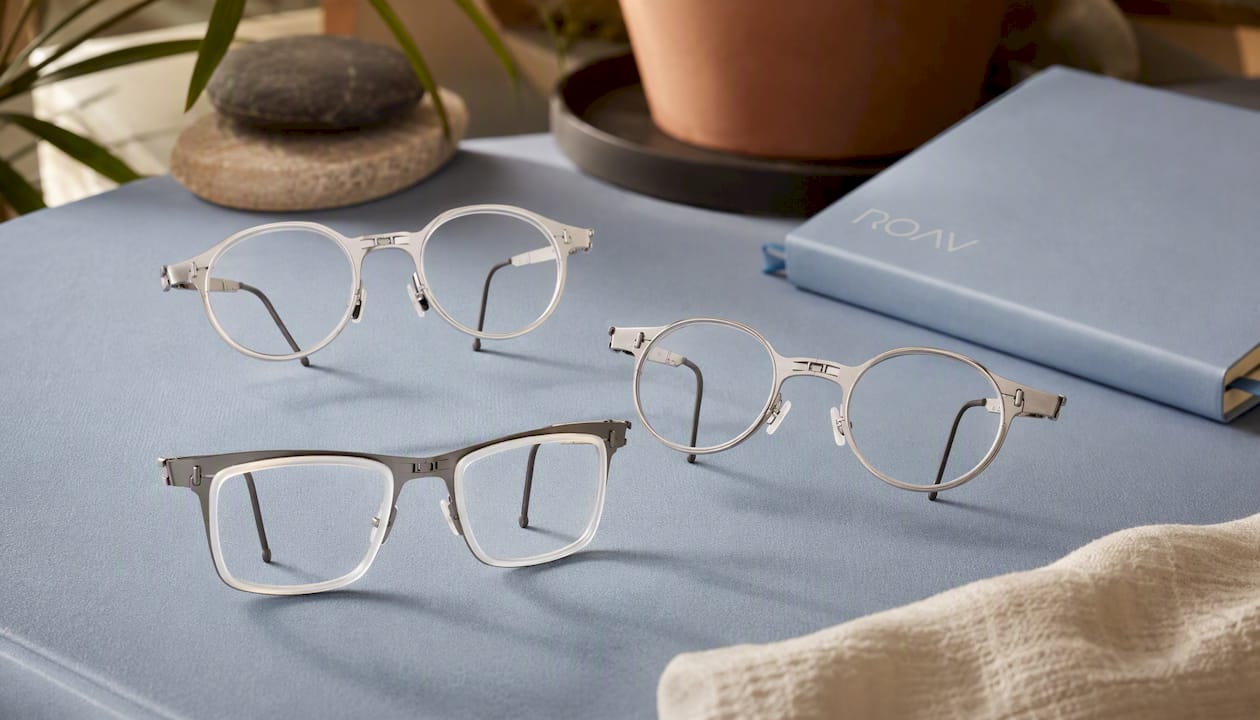
Three styles show how the design plays out in practice. The ACE Steel | Clear pairs a recycled-metal-style steel frame with a compact fold for daily carry. The BOMBAY Steel | Clear leans into the same durable steel construction with a slightly different silhouette for travellers who want a sturdier everyday pair. The DEVON Gunmetal+Crystal | Clear brings a bolder, statement-friendly frame without losing the fold-flat portability the whole collection is built on.
None of these need a hard case that eats space in your bag, and none of them ask you to choose between style and eye protection. Browse the full lineup on the ROAV Eyewear site and pick the fold that matches how you actually travel.
Sources
FAQ
Which material is the most eco-friendly?
There’s no single winner. GRS-certified rPET and recycled metals generally offer the best balance of low impact and long-term durability, while bio-acetate is the top plant-based option when a brand can verify industrial composting access.
What material is considered the safest for sunglasses lenses?
Polycarbonate is the standard choice for impact resistance and safety, and any lens labelled UV400 meets the protection level recommended by the American Academy of Ophthalmology for blocking 99 to 100% of UVA and UVB rays.
What are some chemical-free sunglasses brands?
No frame is entirely free of processing chemicals, but bio-acetate and recycled-metal frames tend to have lower VOC off-gassing than standard petroleum-based plastics, making them a better fit for sensitive skin.
What are some ethical sunglasses brands?
Look for brands that publish verified recycled or bio-based content percentages, hold certifications like GRS or FSC, and offer a repair or take-back policy. ROAV Eyewear builds its foldable collection around durable, screwless construction and UV400 lens protection, which aligns with those same priorities.