

The system that works: a 30 to 40 litre carry-on plus one personal item, a 7 to 10 piece clothing capsule built around merino or synthetic layers, a compact tech kit small enough to fit in one packing cube, and toiletries reduced to solids and decants. Minimalist travel essentials come down to fewer, better items, not deprivation. A pair of folding sunglasses is a good test case: it delivers full UV protection at a fraction of the case size a standard pair needs.
TL;DR:
- Packing 7 to 10 clothing items based on trip length and fabric choice, with merino wool recommended for odour resistance and durability.
- Using a 30 to 40 litre carry-on and one personal item minimizes management while maximizing space for essentials.
- Essential toiletries are solid, decanted liquids, and prescription meds kept in original containers; avoid full-size bottles and packing extras.
- A minimalist tech kit includes one GaN multi-port charger, one cable per device, a power bank under 100 Wh, and only necessary adapters.
- Shoes are limited to two pairs, with foldable sunglasses and multi-purpose accessories that save space and avoid bulky cases.
Table of Contents
- What belongs on a minimalist travel essentials checklist?
- How many clothes do you actually need to pack?
- What toiletries actually need to come with you?
- What tech should actually make the cut?
- How do you choose the right bag and keep it organized?
- Which shoes and small accessories are worth the space?
- What packing rules actually reduce decision fatigue?
- Why foldable sunglasses belong in every one-bag kit
- What health and safety items should stay in a minimalist kit?
- How do you handle souvenirs and laundry on longer trips?
- How do you adapt this system for climate and trip length?
- Why testing your pack matters more than any checklist
- How LENNOX foldable sunglasses fit a minimalist kit
- Sources
What belongs on a minimalist travel essentials checklist?
Before diving into fabrics and gadgets, it helps to see the whole kit laid out in one place. This is the skeleton every packing list below builds from, and it works whether you’re gone for a long weekend or two months.
Bag and carry system
- One 30 to 40 litre carry-on backpack or soft-sided bag as your main piece.
- One slim personal item (tote or sling) for a laptop, passport, and snacks.
- Don’t bring a third bag “just in case.” It always becomes the thing you’re managing instead of your trip.
Clothing (see the next section for exact counts)
- A coordinated capsule where every top matches every bottom, following minimalist dressing principles that simplify outfit formulas and make packing easier (see how minimalist dressing works).
- One layer that handles cold, one that handles rain.
- Don’t pack a full outfit for every day. Repetition is invisible to strangers.
Shoes
- One pair for walking, one pair for anything dressier or wetter.
- Don’t pack shoes “for the gym” you won’t actually use on a ten-day trip.
Toiletries
- Solid shampoo bar, toothpaste tablets, solid deodorant, one multi-use balm.
- Don’t carry full-size bottles of anything you can buy at your destination.
Tech
- One GaN multi-port charger, one short USB-C cable per device, a power bank under 100 Wh.
- Don’t pack a laptop if a tablet or e-reader covers the actual work.
Documents and money
- Passport, one physical card backup, a phone photo of every important document.
- Don’t carry paper boarding passes and printed hotel bookings you’ll never look at twice.
Daypack
- One packable nylon daypack that folds into a pouch the size of a fist.
- Don’t bring a second “just for hiking” bag unless the trip is genuinely built around trails.
Accessories are where people either save the most space or waste the most, depending on what they choose. A collapsible water bottle, a luggage scale the size of a pen, and packable sunglasses all belong in the same category: items that do their job without asking for a dedicated compartment. ROAV Eyewear’s LENNOX Black | Light-Blue folds down with the brand’s patented micro hinge design, so it slides into a jacket pocket instead of eating space in a hard case. That’s the whole logic of a minimalist travel essentials list in miniature: keep the function, lose the bulk.
The most common mistake isn’t over-packing clothes. It’s over-packing “backup” items: a second charger, a spare pair of sunglasses, extra socks beyond what the laundry plan requires. Every one of those items is solving a problem that hasn’t happened yet.
How many clothes do you actually need to pack?
Clothing quantity should scale with trip length, not personal anxiety about running out of options. ChoosePack’s one-bag framework lays out sensible ranges for carry-on-only travel, and they hold up whether you’re gone for a weekend or a month, provided you plan to do laundry along the way.
| Trip length | Tops | Bottoms | Underwear/socks | Outerwear |
|---|---|---|---|---|
| 1 to 3 days | 2 to 3 | 1 to 2 | 3 pairs | 1 layer |
| 4 to 7 days | 4 to 5 | 2 to 3 | 5 to 7 pairs | 1 to 2 layers |
| — | 5 to 7 | 3 to 4 | 7 pairs | 2 layers |
That last row assumes you’ll wash clothes at least once mid-trip, whether in a sink or a laundromat. Beyond two weeks, the numbers barely change. You just do laundry more often.
Fabric choice matters more than quantity. Merino wool resists odour naturally, which lets you wear a shirt three or four times before it needs a wash, according to ChoosePack’s packing guidance. Synthetics like polyester dry fast and pack small, but they hold smell after a single hard day of walking or a warm train car. Cotton is the worst of both worlds for a one-bag setup: slow to dry, bulky when packed, and it wrinkles the moment it’s folded. If you’re choosing one splurge fabric for a capsule, make it merino for shirts and base layers, and save synthetics for anything athletic.
Build your capsule around these rules:
- Pick one colour family so every top pairs with every bottom.
- Bring one piece that can go from casual to slightly dressed up (a button-down, a wrap dress) rather than a separate “nice outfit.”
- Layer instead of packing separate items for separate temperatures: a base layer, a mid layer like a fleece or light sweater, and a shell that blocks wind and light rain.
- Skip anything that only works with one other item in your bag.
AARP’s guidance on packing light points out that odour-resistant fabrics paired with mid-trip laundering let travellers stretch a small wardrobe across a long trip, and that’s not a minor convenience. Airlines collected more than US$7.4 billion in baggage fees in 2025, so every piece of clothing you don’t check is money back in your pocket.
A layering system beats a pile of single-purpose clothes because it multiplies combinations instead of just adding items. Three tops, two bottoms, and two layers gives you far more usable outfits than five tops and one layer, and it weighs less too.
What toiletries actually need to come with you?
Most toiletry bags are heavier than they need to be because people pack full-size liquids out of habit, not necessity. The TSA’s 3-1-1 rule caps carry-on liquids at 100 millilitres per container inside one quart-sized bag, and that limit alone should push you toward solids before you even think about weight.
Solid shampoo bars, toothpaste tablets, and solid deodorant sticks eliminate the liquids problem entirely. None of them count against your 3-1-1 allowance, and a shampoo bar the size of a bar of soap replaces a bottle that would otherwise take up a third of your quart bag. For anything you can’t get in solid form, decant into reusable silicone travel tubes at 30 to 50 millilitres, enough for a week to ten days of use without hauling a full bottle.
Pack this way:
- Solid shampoo, conditioner bar, toothpaste tablets, solid deodorant as your base kit.
- Decant sunscreen, moisturizer, and any liquid product you can’t find solid, into small silicone tubes.
- Bring detergent sheets (flat, laminated, and nearly weightless) for sink washes or a laundromat load mid-trip.
- Skip full-size bottles entirely unless a prescription requires a specific formulation.
- Buy razors, cotton swabs, and other consumables locally once you arrive, rather than packing them.
Rick Steves has long argued that travellers should pack for the best-case scenario and buy replaceable items at the destination instead of hauling them “just in case.” That philosophy applies directly to toiletries: sunscreen, bug spray, and basic first aid items are sold almost everywhere, so there’s little reason to carry a full supply from home.
The exceptions are non-negotiable. Prescription medication, contact lens solution if you wear lenses, and any skincare product treating a medical condition should always travel with you in original, labelled containers, regardless of how much space they take.
Pro Tip: Detergent sheets weigh almost nothing and take up less room than a deck of cards, but they turn any hotel sink into a laundry station. Pack five to eight sheets for a two-week trip and you’ll never need to check a bag just for clothes.
What tech should actually make the cut?
A minimalist tech kit fits in a single small pouch: one charger, one cable style, one power bank, and an adapter only if you’re crossing borders that need one. Anything beyond that is usually solving a problem you don’t have.
A multi-port GaN charger is the single highest-value swap in the entire kit. Job4travelers recommends pairing one GaN charger with a single USB-C cable per device, since GaN chargers run cooler and pack smaller than the old-style block chargers most people still carry, and one unit can charge a phone, tablet, and headphones at once.
The kit that covers almost every trip:
- One multi-port GaN charger (rated for laptop charging if you’re bringing one).
- One USB-C cable per device, plus a USB-C-to-Lightning cable if you use an iPhone.
- One power bank under 100 Wh, packed in your carry-on only, never checked.
- One universal adapter, and only if your destination uses a different plug standard.
- Skip the laptop if an e-reader or tablet covers what you actually need to do.
Power bank capacity is a strict requirement, not a suggestion. Job4travelers notes that airlines require any power bank over 100 Wh to receive prior approval, and most simply refuse them, so anything checked in a bag or larger than that threshold risks confiscation at security. A single 20,000 mAh power bank sits comfortably under that limit and charges a phone four to five times over.
Ask yourself honestly whether you need a laptop before packing one. If your trip involves emails and photo backups rather than spreadsheet work or video editing, a tablet with a keyboard case does the job at a third of the weight.
How do you choose the right bag and keep it organized?
The 30 to 40 litre range is the sweet spot for one-bag travel up to two weeks, according to ChoosePack’s one-bag framework. Go smaller and you’ll be doing laundry every three days; go larger and the bag starts inviting you to fill it with things you don’t need.
Clamshell-opening bags (they unzip flat like a suitcase) make packing cubes easier to see and access than top-loading bags, which force you to dig from the top down. Torso fit matters more than litre count for comfort: a 38L bag on a short torso rides badly, while the same bag on a taller frame sits fine. Try the bag on loaded, not empty, before committing.
Packing cubes and compression cubes solve different problems, and mixing them up wastes both money and space:
- Packing cubes organize by category (one for tops, one for underwear, one for tech) so you’re not unpacking the whole bag to find socks.
- Compression cubes use a zip-and-squeeze mechanism to physically shrink the volume of soft items like jackets and sweaters.
- A set of three to five cubes covers most one-bag setups: two standard cubes for clothing, one compression cube for bulky layers, and one small pouch for toiletries or tech.
- Compression only saves space with compressible fabrics. It does nothing for shoes or hard-sided items, and packing everything tight can quietly push your bag over an airline’s weight limit even though it looks smaller.
REI’s expert packing advice recommends testing your packed bag for comfort before you leave home, and that step catches more problems than any checklist ever will.
Pro Tip: Pack your bag completely, then wear it around your home or neighbourhood for a full day, groceries, stairs, transit and all. Whatever you never reach for gets pulled before the trip. This single habit trims more weight than any gear swap.
Which shoes and small accessories are worth the space?
Two pairs of shoes is the practical ceiling for almost any one-bag trip: one for walking and daily wear, one for anything dressier, wetter, or more technical. Wear the bulkier pair on travel days since they take up zero packed space when they’re on your feet, and let the second pair ride in a shoe bag inside the main compartment.
Small accessories that earn their spot:
- A packable nylon daypack that folds into a pouch for day trips and airport layovers.
- A thin dry bag for wet swimsuits, damp shoes, or as a laundry separator.
- A luggage scale the size of a permanent marker, so you’re never guessing at the airport counter.
- Foldable sunglasses instead of a rigid case that eats a third of a toiletry pouch.
Eyewear is an easy category to overlook until you’re the person digging a bulky hard case out from under three shirts. ROAV Eyewear’s LENNOX Gunmetal | Silver folds flat using the brand’s screwless micro hinge design, so it travels in a slim pouch rather than a rigid clamshell case. For anyone building a kit around function first, that’s the same logic driving every other choice on this list: does the item pull its weight relative to the space it occupies? A guide on packing sunglasses efficiently walks through the small details, like which pocket to use and how to avoid scratched lenses, that make the difference between a folding pair that survives a trip and one that doesn’t.
Multi-use is the filter for everything else in this category. A merino buff works as a scarf, an eye mask, and a hair tie. A travel steamer is nice but optional. Skip it unless you’re packing garments that genuinely need it.
What packing rules actually reduce decision fatigue?
Named rules work because they remove the endless “should I bring this?” debate before it starts. The two most common frameworks, referenced across most one-bag packing guides, are the 5-4-3-2-1 rule and the 3-3-3 rule.
The 5-4-3-2-1 rule works for longer trips: five tops, four bottoms, three pairs of shoes (usually worn, not packed), two “extra” items like a dress or blazer, and one swimsuit. The 3-3-3 rule suits shorter or warm-weather trips: three tops, three bottoms, three pairs of shoes and accessories combined. Neither is a law. Both exist to give you a starting number instead of an open-ended pile.
A few packing habits that matter more than the rule you follow:
- Roll clothes you’ll wear often (t-shirts, casual pants); fold structured pieces like blazers or dress shirts to avoid crease lines.
- Stomp-dry socks and underwear in the shower after a sink wash. Wringing by hand leaves them damp for hours longer.
- Use jacket and cargo pockets for small items like cables or sunglasses instead of a separate pouch.
- Pack the night before, then walk around your home wearing the full bag for an hour to catch discomfort before the airport does.
A sample seven-day timeline:
- Five days out: pull the capsule wardrobe and lay it out.
- Three days out: pack the bag fully and do the 24-hour live test.
- One day out: remove anything you didn’t touch during the test.
- Departure day: wear your bulkiest layer and shoes, pack the rest.
Why foldable sunglasses belong in every one-bag kit
One specific problem with eyewear is that it is often bulky due to the hard case, not the frame. Some foldable sunglasses use micro hinge technology to fold down the frame to a very compact size, without compromising on polarized UV protection or frame durability.
Many customers choose foldable frames specifically because they solve a packing problem, not just a fashion one. A pair that folds flat slides into a jacket’s chest pocket on a plane, a daypack’s front sleeve on a hike, or a shirt pocket at a beach bar, none of which work with a standard rigid case. That’s a real difference for anyone building a kit where every cubic inch is accounted for.
For readers weighing eyewear options against the rest of their gear, ROAV Eyewear’s guide on folding sunglasses for travel breaks down frame materials and hinge durability, and the brand’s carry-on sunglasses guide covers sizing against typical daypack and personal-item dimensions.
What health and safety items should stay in a minimalist kit?
Cutting volume should never mean cutting the items that keep you safe or functional if something goes wrong. A minimalist first-aid kit fits in a pouch smaller than a phone case: adhesive bandages, a few doses of pain reliever, one antidiarrheal medication, and any personal prescription in its original labelled packaging.
Prescription medication is the one category where “buy it there” doesn’t apply reliably. Dosages, brand names, and even active ingredients vary by country, so carry enough for your full trip plus a few extra days, split between your main bag and personal item in case one gets lost.
A physical copy of your travel insurance policy number and emergency contacts, kept separately from your phone, matters more than most people assume. Phones die, get stolen, or lose signal at exactly the moment you need that information. A small paper copy tucked in a passport wallet weighs nothing and solves a real problem.
Sun protection deserves the same seriousness as any other health item, not an afterthought. A compact pair of polarized sunglasses and a travel-size sunscreen decant protect against UV exposure on long walking days, and both fit into the same small pouch as your other toiletries. Minimalist packing means fewer items, never fewer safeguards.
How do you handle souvenirs and laundry on longer trips?
Souvenirs are the single biggest threat to a carefully packed one-bag setup, because they arrive unplanned partway through a trip and have nowhere pre-assigned to go. The simplest fix is a rule set before you leave: only buy something if it’s consumable (food, wine, coffee), replaces an item already in your bag, or is small enough to fit in a jacket pocket.
Photos and experiences hold up better than objects as souvenirs anyway, and they add zero grams to your pack. For anyone who genuinely wants a physical memento, shipping it home directly from the destination almost always costs less than the overweight baggage fee you’d otherwise pay to carry it.
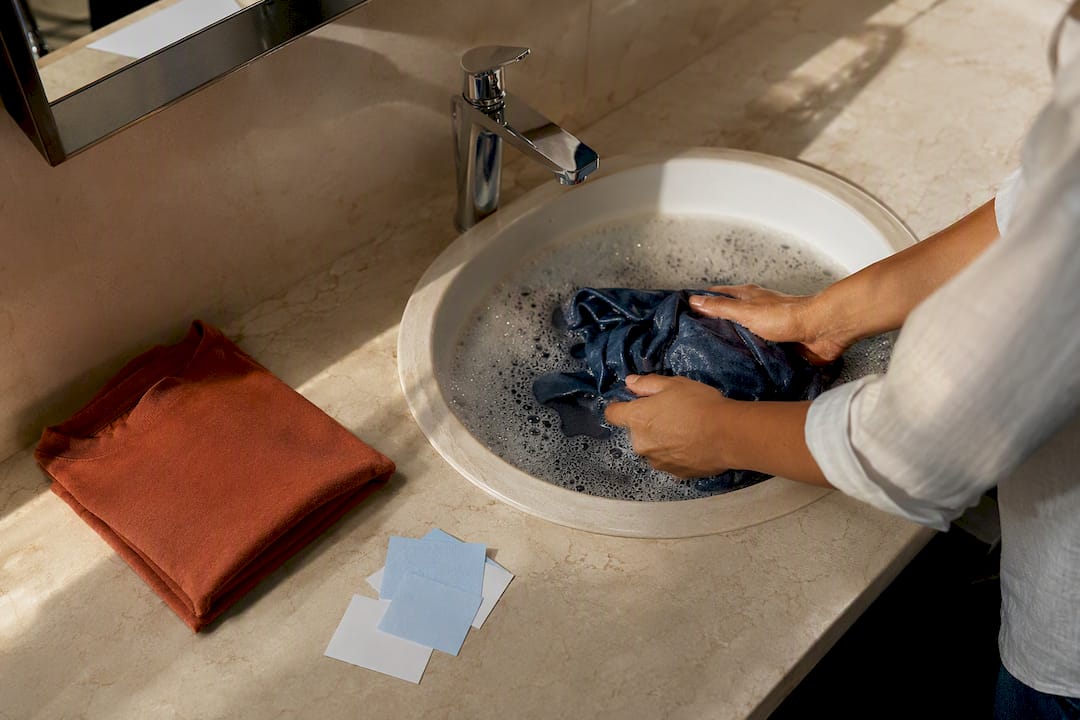
Laundry on extended trips works best as a rhythm, not a scramble. Wash small loads in a sink every three to four days using detergent sheets, and save laundromat or hotel laundry service for a full reset once a week or so. This keeps your capsule wardrobe cycling instead of piling up dirty clothes that eventually force an emergency laundry day in the middle of something more interesting. Hostels and short-term rentals increasingly list laundry access as a filterable amenity, which makes planning around wash days easier than it used to be.
How do you adapt this system for climate and trip length?
The core kit barely changes between a four-day city trip and a six-week backpacking route. What changes is the outer layer and the ratio of quick-dry to warm fabrics, not the underlying structure.
For hot, humid climates, lean almost entirely on synthetics and lightweight linen-blends over merino, since heavy wool overheats fast in tropical conditions. Swap the mid-layer fleece for a light long-sleeve shirt that doubles as sun protection, and add a second pair of quick-dry underwear since sweat means more frequent washing.
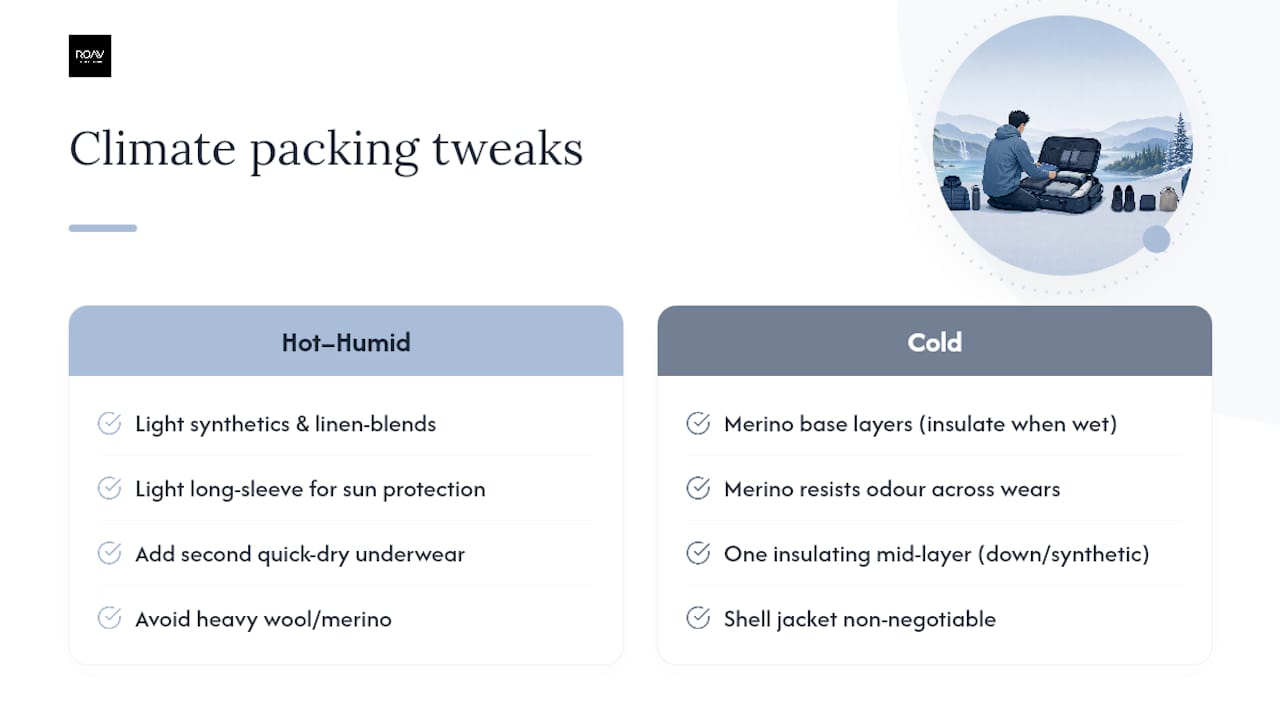
For cold climates, merino base layers earn their keep even more, since they insulate while wet and resist odour across multiple wears when a hot shower isn’t guaranteed. Add one insulating mid-layer (down or synthetic fill) and treat your shell jacket as non-negotiable rather than optional.
Trip length changes laundry frequency more than it changes what you pack. A ten-day trip and a ten-week trip can use the exact same capsule wardrobe from the earlier table, provided the ten-week traveller commits to washing every four to five days instead of packing triple the clothing. More days away simply means the laundry rhythm becomes routine instead of an occasional chore.
Why testing your pack matters more than any checklist
I once assumed a “just in case” travel adapter earned its space in my bag for three straight trips before I actually needed it once. That’s the trap: an item feels essential right up until you track whether you’ve touched it.
Minimalist travel isn’t about deprivation. It’s about being honest with yourself about what you actually use, then trusting that anything genuinely missing can be bought at your destination. Pack the bag, live with it for a day, and let the results tell you what stays.
— Thomas
How LENNOX foldable sunglasses fit a minimalist kit
Sunglasses are one of the few accessories where “minimalist” doesn’t mean “basic.” Some foldable sunglasses fold flat using a screwless micro hinge design, offering full frame durability and polarized UV protection without a rigid case taking up space.
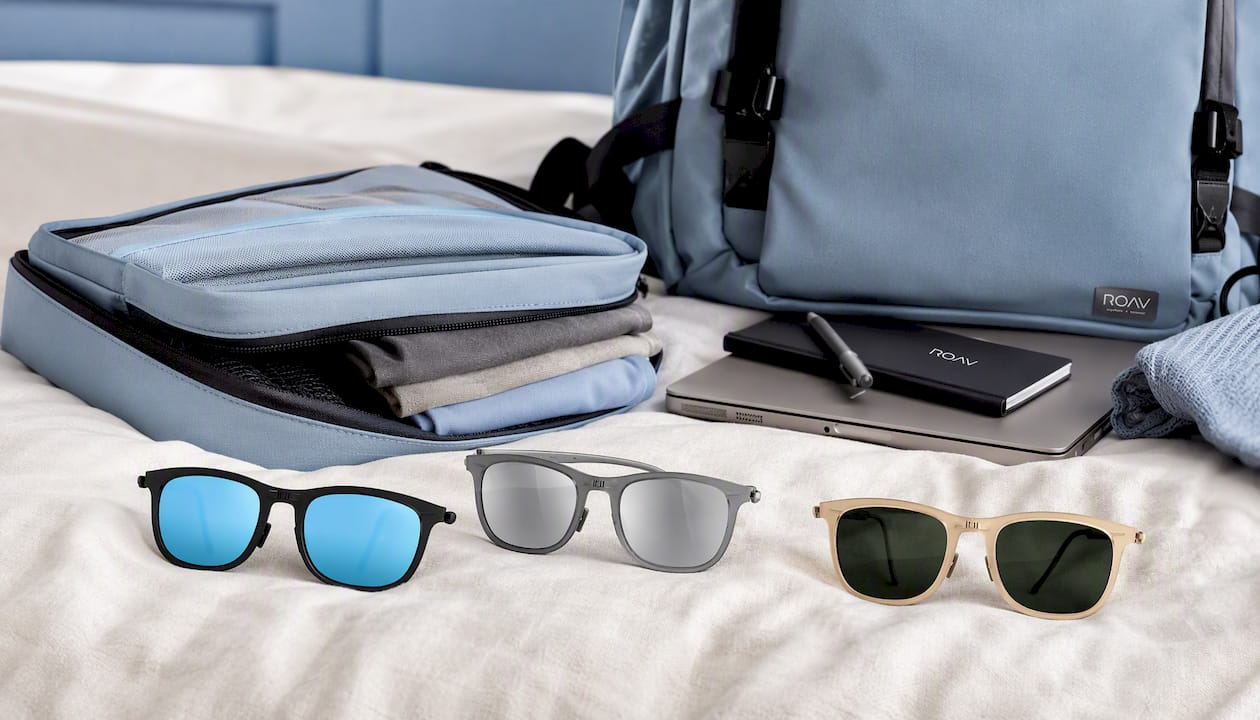
Each colourway suits a different kind of traveller. The LENNOX Black | Light-Blue leans urban and versatile, easy to pair with any outfit from a business trip to a weekend away. The LENNOX Gunmetal | Silver suits outdoor-leaning travellers who want a neutral frame that won’t clash with hiking or cycling gear. The LENNOX Gold | G15 skews more style-forward, a good pick for anyone who treats eyewear as part of the outfit rather than an afterthought.
These fold down small enough to slide into a jacket’s chest pocket, a daypack’s front sleeve, or the same pouch as toiletries, no separate hard case required. Have a look at the full LENNOX collection and see which frame fits how you actually travel.
Sources
- How to pack light to travel with ease — AARP (2026)
- Rick Steves reveals suitcase essentials — Islands
- One bag travel packing list | ChoosePack
- Digital Nomad Packing Checklist 2026 — job4travelers
- Traveling light — REI expert advice