

The best packable travel accessories do two jobs: they organize or protect something you already carry, and they take up almost no room doing it. Think compression packing cubes, a folding hook, a universal adapter and a pair of sunglasses that collapse small enough for a jacket pocket. This guide covers what is worth packing, what to leave home, and how to look after the small items that tend to get crushed in a bag.
TL;DR
- Pick a few multipurpose items over “just-in-case” gear. Every accessory should replace something or protect something.
- Compression packing cubes are the simplest space saver. Vacuum bags squeeze harder, but cubes are easier to live with.
- Sunglasses are a travel accessory too. Look for a UVA and UVB label, because price, lens colour and darkness do not tell you.
- Give eyewear a sturdy case and a small cleaning kit, and it will survive a long trip.
- Foldable frames, like our micro hinge designs, solve the bulk problem for eyewear specifically.
Table of Contents
- How to decide what earns a spot
- Packing organizers that actually save space
- Small tools worth the few grams
- Sunglasses: the accessory people forget to pack small
- Keeping eyewear safe in a packed bag
- A minimalist kit, laid out
- Buying smart
- Compact eyewear as an employee gift
- Foldable frames for your next trip
- FAQ
- Sources
How to decide what earns a spot
Most overpacking comes from buying a gadget for every imaginable problem. Long-term minimalist travellers tend to land on the same rule: carry a few multipurpose, high-quality, light and small items, skip “just-in-case” gear, and buy what you need locally when something unexpected comes up. One veteran minimalist traveller describes this as an art of refinement that years of constant movement teach you.
A useful test before anything goes in the bag:
- Does it replace something? A folding hook replaces a hanger. A good pair of sunglasses replaces the second, backup pair.
- Does it protect something expensive? A case for your glasses or a pouch for your charger is cheap insurance.
- Will you use it on most days? If the answer is “only if something goes wrong”, it is probably a candidate to leave behind.
- How small does it get? Packable means it shrinks, folds or nests. If it keeps its full volume in your bag, it is just another thing you carry.
Shoes follow the same logic. Lonely Planet’s packing advice suggests limiting footwear to two pairs, usually comfortable sneakers plus sandals that can be dressed up in warm destinations. Fewer bulky items means fewer accessories needed to manage them.
Packing organizers that actually save space
Compression packing cubes
If you buy one accessory, make it compression cubes. Travel + Leisure’s tested list recommends them for saving space and organizing clothing. Its tested Bagsmart set comes in six sizes and includes a transparent pocket for labelling contents, which is handy when you are digging for socks in a hostel dorm at 6 a.m.

Sizes matter. Travel expert Marina Radlinski, quoted by NBC Select, recommends packing cubes in varied sizes for different needs, for example a small one for underwear and socks and a larger one for sweaters. Mixing sizes also lets you fill awkward gaps in a carry-on.
Vacuum storage bags
Vacuum bags go further. According to Condé Nast Traveler, they can turn bulky clothing into flat, stackable components, while compression cubes are a simpler alternative. In practice: use vacuum bags for winter layers on a trip to a cold destination, and cubes for everything else, since cubes do not need a pump or a sealed bag to stay compressed.
A pouch for the small stuff
Cables, adapters, earbuds and a spare battery are the items that migrate to the bottom of a bag. One zippered pouch keeps them together. Label it, keep it in the same pocket every trip, and you will stop re-buying chargers at airports.
Small tools worth the few grams
A universal travel adapter. The same Travel + Leisure roundup points to a universal adapter that can charge multiple devices at once, which means one plug instead of three.
A clip-and-hook. The Gear Aid Heroclip is a compact accessory that works as both a carabiner and a folding hook, as cited by Minimalist.Travel. It is useful for hanging a bag in a crowded train bathroom or a hostel room with no hooks.
A travel tote. A small tote that folds into its own pocket doubles as a market bag, a beach bag or a personal item when your carry-on is full on the return leg.
Reusable toiletry bottles. Decant only what the trip needs. Smaller containers mean a smaller pouch and less to leak.

If you pack a phone for photos, protect the lens too. A short guide on how to protect your phone camera lens walks through options that do not hurt photo quality, which matters when the phone is your only camera.
Sunglasses: the accessory people forget to pack small
Sunglasses are usually the bulkiest rigid thing in a day bag. A standard pair needs a hard case, and a hard case is a brick. That is the problem we built our frames to solve: the patented micro hinge lets the frame fold down to a very compact size, so the pair slips into a jacket pocket, a small bag or a carry-on side pocket.
But compact is only half the job. The other half is protection, and the guidance from Canadian sources is clear.
What to check on any pair
- A UVA and UVB label. Health Canada says sunglasses should provide UVA and UVB protection, and that you cannot judge this by price, lens colour or lens darkness.
- Coverage. Close-fitting or wraparound eyewear helps limit light entering from the side.
- Scratch resistance. Health Canada also recommends scratch-resistant coatings for plastic lenses, which is relevant for anything that lives in a bag.
- Know what polarization does. McGill University’s Office for Science and Society notes that dark lenses can improve comfort but do not guarantee UV protection, and that polarized lenses mainly reduce glare rather than improve UV blocking. So polarization is a comfort feature for water, snow and driving, and the UV label is the protection feature. Look for both.
When you need them most
Don’t save sunglasses for the beach. Environment and Climate Change Canada advises wearing UV-protective sunglasses outdoors and checking the UV Index forecast, with protection recommended at a UV Index of 3 or higher. The same guidance notes that snow reflection can nearly double UV strength, so a ski trip or a winter hike in the Rockies is a sunglasses trip. If you want a deeper look at the labels, our guide to verifying that sunglasses block UVA and UVB applies to foldable frames as well.
Canadian standards and price: what to know
Canada has no mandatory standards for sunglasses, according to the McGill piece. A study of more than 200 pairs sold in Quebec City found that all pairs above $21 and almost all cheaper pairs met UV-filtering standards. The takeaway is not that price tells you everything, since Health Canada says it does not. It is that the label and the seller matter, so buy from a retailer that states UV protection plainly and has a return policy you can read.
If you want a travel-specific shortlist, we have written about packable UV400 sunglasses for high-UV destinations, and about foldable metal frame sunglasses if you prefer a lighter, more structured look.
Keeping eyewear safe in a packed bag
Compact eyewear still needs protection from pressure and grit. Vision First, a Canadian optical group, recommends a hard or sturdy case and a care kit with a cleaning cloth, eyewear-cleaning solution and a small screwdriver. It also advises against cleaning lenses with ammonia, bleach, vinegar or window cleaner.
Hard cases are strongest but bulkier, while a microfiber cloth is what actually cleans the lens, as one travel packing guide notes. A small repair kit can also help with common issues: a loose nose pad may need only a quick push or a screw adjustment.
Our frames are screwless, which removes one of the most common tiny failures, the lost screw. They also ship with a waterproof pouch, so you have a protective sleeve from the first day. For a trip kit, add a cloth and a small bottle of lens cleaner and you are covered. We have a step-by-step on three fast ways to clean sunglasses while travelling and a note on cleaning polarized lenses without solvents.
Our perspective
We started from a plain frustration: good sunglasses are the one item that never packs well. Everything else in a carry-on can be squeezed, rolled or nested. Rigid frames cannot, so they end up on your head indoors, in a cup holder, or crushed in a coat pocket.
That is why we built around the micro hinge. When a frame folds down small, the whole packing logic changes. You stop choosing between bringing the nice pair and keeping the bag light. Our design is also screwless and lightweight, which we think matters more for travellers than any styling detail, because things that loosen and fall apart are the ones that fail in a different time zone.
We would rather you carry one pair you trust than three you hedge with. Check for UVA and UVB protection, pick a frame you will actually wear, keep it in its pouch, and forget about it until the sun comes out. Over 100,000 customers have chosen our frames for exactly that kind of simple, useful routine.
Thomas
A minimalist kit, laid out
Here is a lean accessory list for a one-bag trip. Adjust for climate and length.
| Item | What it replaces or protects | Why it is packable |
|---|---|---|
| Compression packing cubes | Loose clothing, extra bag space | Flatten when empty, compress when full |
| Folding hook or clip | Hangers, floor space | Pocket-sized |
| Universal adapter | Several country-specific plugs | One item charges multiple devices |
| Foldable sunglasses with pouch | Bulky hard-case pair | Collapse to a very compact size |
| Microfiber cloth | Lens wipes, shirt hems | Weighs next to nothing |
| Foldable tote | Extra bag for souvenirs | Folds into a pocket |
| Reusable small bottles | Full-size toiletries | Carry only what you need |
The goal of the 30 to 40 litre approach is skipping checked-bag fees and baggage carousels. If that is your plan, our piece on minimalist travel essentials for one bag goes through the full list, and our backpacking sunglasses guide covers what to choose when every gram is counted.
Buying smart
Accessories are small purchases, but they add up before a trip. Buy the items that protect something expensive first, such as a case or a good pouch. Buy the convenience items second. Skip anything you cannot explain in one sentence.
If you are also shopping for a new bag, timing matters. This explainer on when to buy luggage looks at price history so you can avoid paying peak price right before holiday travel. Accessories are rarely worth rushing, so buy them a few weeks ahead, test your packing at home, and return what does not fit your routine.
Compact eyewear as an employee gift
If you are buying for a team, such as a sales group that travels or staff heading to an off-site, think about what a gift does after the first week. A few practical points:
- It should fit in a work bag. A gift that folds small is more likely to be carried than one that needs its own case.
- Style should be broad. Neutral colours and classic shapes suit more faces and tastes than a trend piece. Our guide to sunglasses for round faces is a good start for matching shapes.
- UV protection is the baseline. Look for the UVA and UVB label, as described above.
- Think about prescription. Not every recipient wears sunglasses only. We also make foldable prescription eyeglasses, so you can browse our eyeglasses collection when the gift is more personal.
For bulk or corporate orders, reach out through our site and we will go through what is possible.
Foldable frames for your next trip
If your accessory list is already tight, sunglasses are the item most likely to cost you space or get damaged. Our foldable collection is built around the patented micro hinge, with polarized UV protection, screwless frames and a waterproof pouch included. Browse foldable sunglasses to compare styles, or start from the full sunglasses range.
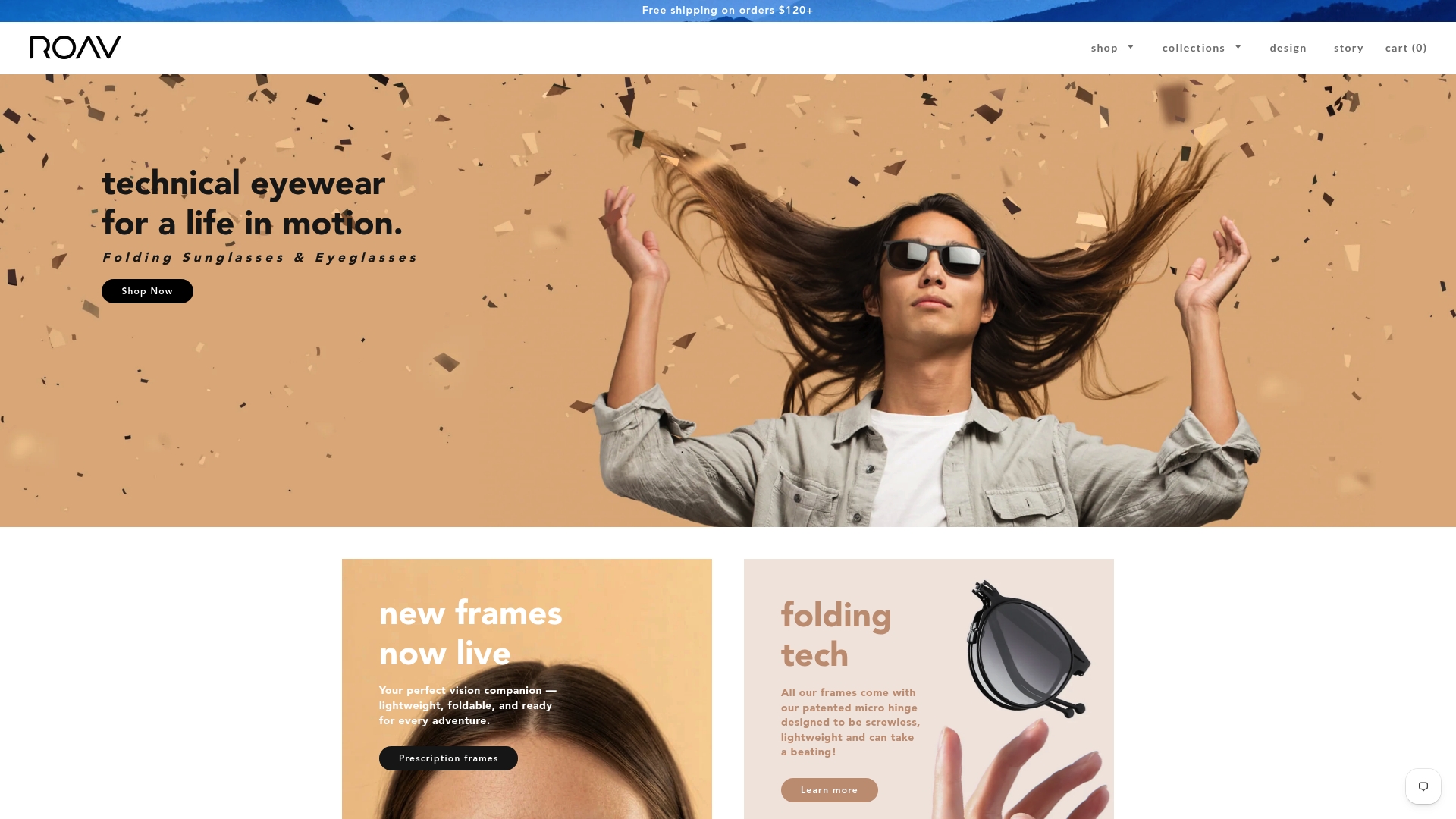
If you already know your style, look at a single frame such as the SKYLANDER Black Moonrise or the INGRID Black Blue-Gradient. Visit ROAV Eyewear for current prices and availability in Canada.
FAQ
What are the most useful packable travel accessories?
Start with compression packing cubes, a universal adapter, a folding hook or clip, a foldable tote and a compact pair of sunglasses with a pouch. Each one either replaces something bulkier or protects something you already carry. Add others only if you can name when you will use them.
How do minimalist travellers reduce bulk without losing style?
They choose fewer, better items that mix and match, such as solid-colour clothing and a single pair of versatile shoes. They avoid “just-in-case” gear and buy missing items locally. Accessories like foldable sunglasses let you keep a pair you like without giving up pocket space.
What should I look for in compact sunglasses?
A UVA and UVB label comes first, since Health Canada says price, colour and darkness do not show protection. Then check fit, scratch resistance, weight and how small the frame folds. Polarization helps with glare but is not a substitute for UV protection.
How do I protect glasses in a packed bag?
Keep them in a sturdy case or pouch, clean them with a microfiber cloth and avoid household cleaners such as window spray, vinegar or bleach. A small repair kit helps with loose nose pads or screws. A screwless frame removes one of the common loose-part problems.
Do I need sunglasses in winter?
Yes, when the UV Index is 3 or higher, according to Environment and Climate Change Canada. Snow reflection can nearly double UV strength, so winter trips, skiing and snowshoeing call for UV-protective sunglasses.
Sources
- The 15 Best Travel Accessories, Tested and Reviewed, Travel + Leisure
- How to fit more in your suitcase, Condé Nast Traveler
- Minimalist Packing List, Minimalist.Travel
- How to Pack Light for Travel, Lonely Planet
- The Best Packing Cubes, According to Travel Experts, NBC News Select
- Sunglasses, Health Canada
- Ultraviolet (UV) index and sun safety, Environment and Climate Change Canada
- Looking at the Science of Sunglasses, McGill Office for Science and Society
- Taking Care of Your New Glasses, Vision First
- 11+ Tips for Packing Eyewear When You Travel, Her Packing List
- How to Protect Your Phone Camera Lens
- When to Buy Luggage