

Pair the two by echoing tone (black frames, black hardware) or contrasting deliberately (black frames, tan leather) rather than chasing matching logos. A folding pair like those designed with compactness in mind solves the bulk problem that makes most men avoid carrying sunglasses and a slim wallet at the same time.
TL;DR:
- Most men overlook the importance of UV protection labels, so always verify sunglasses are rated UV400 or 100% UV before purchase.
- Proper fit involves checking temple grip, bridge contact, eyelash clearance, cheek clearance, and stability to ensure the sunglasses stay useful over time.
- Wraparound or oversized frames provide better side coverage against sunlight, especially near water or reflective surfaces where light sneaks in from the sides.
- Polarized lenses reduce horizontal glare but do not automatically offer UV protection; check both features separately for optimal eye safety.
- Foldable sunglasses with micro hinge mechanisms offer a compact, durable option that easily fits in a slim wallet or pocket, ideal for everyday carry.
Table of Contents
- The two-minute fit and safety check for sunglasses
- Choosing sunglass lenses: tints, polarization, and materials that match how you live
- Wallet types and how to pick one that won’t ruin your silhouette
- How to pair sunglasses and a wallet without overthinking it
- A concise buying checklist: what to confirm before you buy
- Why foldable sunglasses solve the everyday-carry problem
- Portability features that actually matter for pocket carry
- What actually matters when you buy both together
- ROAV foldables built for a slim, coordinated carry
- Sources
- FAQ
The two-minute fit and safety check for sunglasses
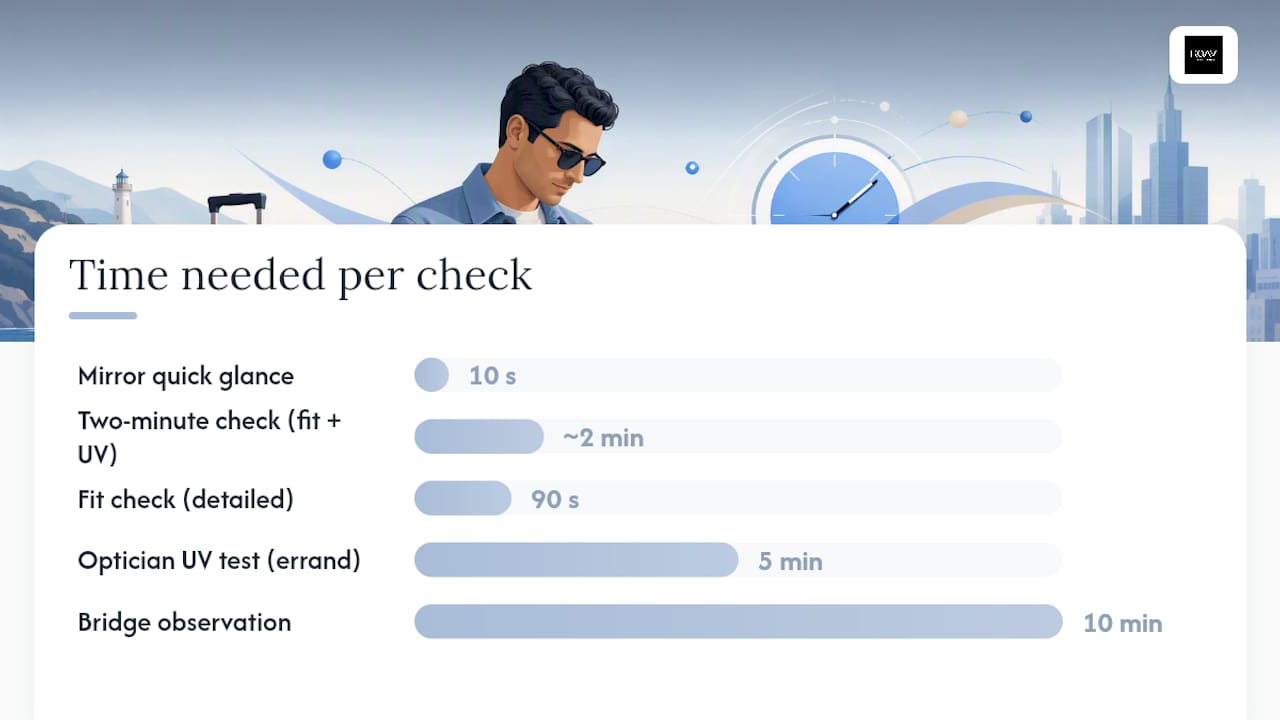
Most men buy sunglasses by looking in a mirror for ten seconds and calling it done. That skips the two checks that actually matter: whether the lenses block UV and whether the frame fits your face well enough to stay useful.
Start with the label explaining UV protection. Sunglasses need to say 100% UV protection or UV400 somewhere on the tag, sticker, or product page. Colour tells you nothing about UV blocking. A pair of pale yellow lenses can carry full UV protection while a pair of near-black lenses carries none, and dark tint without a UV filter can actually do more harm than going without sunglasses, because darker lenses trick your pupils into dilating and pulling in more unfiltered light. If a pair has no UV labelling anywhere, walk away or ask the retailer directly before you buy.
Fit comes next, and it takes about ninety seconds to check properly:
- Temple grip: the arms should rest on your ears without pinching or sliding down within the first few minutes of wear.
- Bridge fit: the nose pads or bridge should sit without gapping or leaving red marks after ten minutes.
- Eyelash clearance: lenses shouldn’t brush your eyelashes when you blink.
- Cheek clearance: frames shouldn’t touch your cheeks when you smile or talk.
- Stability test: look down and shake your head gently. Good frames don’t slide.
Coverage matters more than most men assume. A standard frame blocks light from the front but leaves gaps at the temples where sunlight sneaks in sideways, especially at midday or on water. Wraparound shapes or slightly oversized frames reduce that side exposure and are worth considering if you spend real time outdoors, driving, or near reflective surfaces like snow or open water.
Pro Tip: If you’re buying an expensive pair secondhand or from a source without clear UV labelling, an optician can test the lenses with a UV light meter in a couple of minutes. It’s a five-minute errand that settles the question for good, and REI’s buying guide recommends it for exactly this reason.
Choosing sunglass lenses: tints, polarization, and materials that match how you live
Tint is a functional decision, not just an aesthetic one. The colour of your lenses changes contrast and light transmission in ways that suit some activities and hurt others.
Here’s how the main tints break down by use case:
- Grey: the most neutral option, preserving true colour perception. Best for general everyday wear and bright, sunny days.
- Brown or amber: boosts contrast against green and blue backgrounds, which is why driving-focused guidance consistently recommends it for road use and variable light.
- Green: a middle ground between grey’s neutrality and brown’s contrast boost, good for golf, hiking, and general outdoor sport.
- Yellow: brightens low light and flat conditions, useful for overcast days or dawn and dusk activity, though it’s a poor choice under strong midday sun.
Polarization is a separate feature entirely, and this is where most buyers get confused. Polarized lenses filter out horizontal glare, the kind that bounces off water, wet pavement, and car hoods. REI’s guidance is direct on this point: polarization improves comfort and cuts glare, but it says nothing about UV protection. A pair can be polarized with zero UV filtering, or UV400 rated with no polarization at all. Check both specs separately, and if you drive often or spend time near water or snow, polarized lenses are worth the added cost.
Lens material changes how the glasses feel and hold up:
| Material | Strength | Trade-off |
|---|---|---|
| Glass | Sharpest optical clarity | Heavier, can shatter on impact |
| Polycarbonate | Lightweight, highly impact-resistant | Slightly lower optical clarity than glass |
| Polyurethane | Premium impact resistance, good clarity | Higher price point |
Coatings add another layer of function. Mirror coatings cut glare further and suit bright, high-altitude, or water environments. Anti-reflective coating reduces internal reflections that can distract you while driving at night. Hydrophobic coatings shed rain and fingerprints. Scratch-resistant coatings matter most if your sunglasses live in a pocket or bag without a hard case.
Pro Tip: If you only remember one rule from this section, make it this: check UV400 first, pick tint for your activity second, and treat polarization as a comfort upgrade rather than a safety requirement.
Visible Light Transmission (VLT) measures how much light passes through a lens, usually expressed as a percentage.
Wallet types and how to pick one that won’t ruin your silhouette
The wallet you carry should match what’s actually in your pockets, not what looked good in a store display. Three form factors cover almost every real-world need.
A cardholder suits men carrying two to six cards and little or no cash. It’s the slimmest option and the one that pairs most naturally with a folded pair of sunglasses in a jacket pocket. A bifold fits men who carry cards plus occasional cash, folded bills, or a few receipts, and remains the most common everyday choice. A long or travel wallet makes sense if you’re regularly holding boarding passes, larger bills, or a passport alongside your cards. It’s bulkier by design and works better in a bag than a back pocket.
Closed thickness matters more than most men think about until they sit down wrong. Style guides consistently point to slim wallets and cardholders as the way to preserve a clean trouser line and avoid the seat discomfort that comes from a fat wallet pressing into your leg for eight hours. A simple test: if your wallet closed is thicker than the width of two stacked phone cases, it’s carrying too much.
Leather quality separates a wallet that lasts a decade from one that cracks in a year. Here’s what the grading actually means:
- Full-grain leather: the entire hide, unsanded, with natural texture intact. The strongest and longest-lasting option.
- Top-grain leather: the top layer sanded and refinished for a smoother look. Slightly less durable than full-grain but still solid.
- Split leather: the lower layers split off from the hide, weaker and often coated to look better than it performs.
- “Genuine leather”: despite sounding premium, this label often refers to lower-grade split leather. It’s real leather, but it’s the bottom of the quality range, not the top.
Ask the retailer directly which grade you’re buying rather than trusting the word “leather” on its own. Beyond grading, check the stitching. Even, tight stitch lines and cleanly folded edges signal real construction care. Loose threads or glued edges usually mean the wallet won’t survive daily use. A metal wallet or card case makes sense if you carry very few cards and want maximum durability with zero break-in period, though it sacrifices the flexibility leather offers.
Pro Tip: Condition leather wallets every few months with a proper leather conditioner, and keep them away from prolonged moisture. Water is the fastest way to warp a good hide and undo years of use in one soaked afternoon.
How to pair sunglasses and a wallet without overthinking it
Coordinating two accessories doesn’t require a colour wheel. Three rules cover nearly every situation.
- Echo the tone. Black acetate frames pair naturally with black or dark brown leather and matching dark hardware. Gunmetal or steel-toned metal frames pair well with grey or cool-toned leather. This is the low-effort default and it almost never looks wrong.
- Use contrast on purpose. Black frames against a tan or cognac wallet create a deliberate accent rather than an accident. This works best when one item is clearly the “quiet” piece and the other adds the pop. Skip this if you’re not confident about intentional contrast.
- Match material formality. Polished metal or mirrored frames look sharper against sleeker, smoother leather. Matte acetate frames sit better with textured or pebbled leather. Mixing a highly polished frame with rough, casual leather tends to look mismatched even when the colours line up.
A few quick real-world examples: for a commute, black acetate frames with a slim black cardholder keep everything low-profile in a blazer pocket. For a weekend outing, tortoiseshell or brown-toned frames with a cognac bifold leans warmer and more casual. For travel, foldable frames tucked into a protective pouch alongside a long wallet holding boarding passes keep your carry compact through security lines. For a date night, gunmetal or silver-mirror frames with a sleek black cardholder read as polished without trying too hard.
A concise buying checklist: what to confirm before you buy
Run through this list before you hand over your card, whether you’re standing in a store or checking out online.
For sunglasses:
- Confirm the label states UV400 or 100% UV protection.
- Check whether polarization matters for how you’ll use them (driving, water, snow).
- Try them on and run the fit checks: temple grip, bridge fit, eyelash and cheek clearance.
- Review the retailer’s return and warranty policy before buying, especially online.
- Note the lens material (glass, polycarbonate, or polyurethane) based on how roughly you’ll treat them.
For wallets: 6. Confirm card capacity matches what you actually carry, not what you might carry someday. 7. Measure closed thickness against your usual pocket, or check the listed dimensions online. 8. Inspect leather grade and stitching quality, or ask directly if buying in person. 9. Verify the return policy, particularly for online leather purchases where colour and texture vary from photos. 10. Check whether a protective case, pouch, or travel sleeve is included for either item.
Why foldable sunglasses solve the everyday-carry problem
Most sunglasses are built to sit on your face or live in a bulky hard case, not to travel with a slim wallet in a jacket pocket. That’s the exact gap ROAV Eyewear built its designs around, using a patented micro hinge system that lets a full-sized frame fold down to something close to the footprint of a phone.
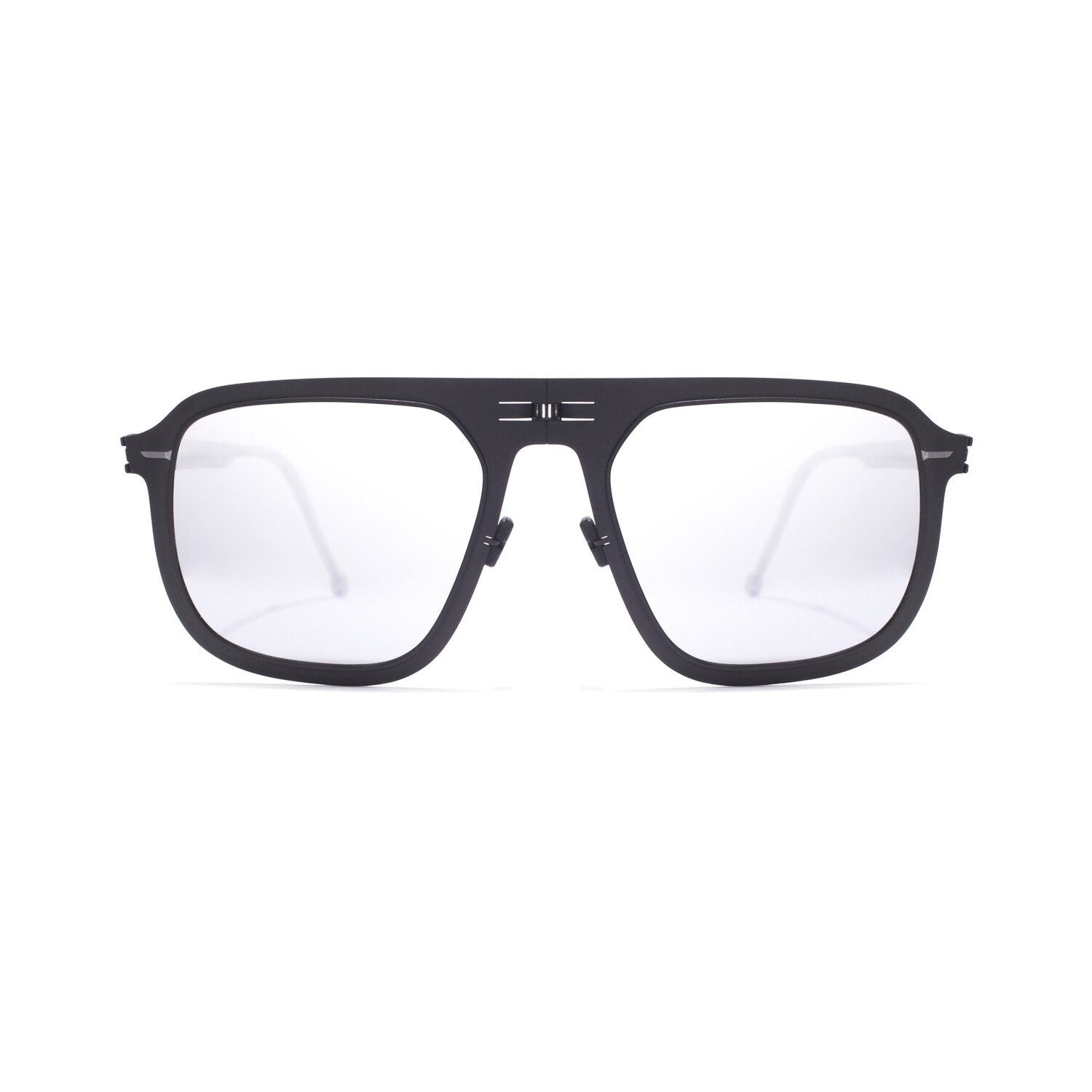
For commuting, travel, and anyone who wants to keep a slim cardholder instead of a bulky bifold, that compact fold changes the calculation. A standard pair of sunglasses forces a choice: carry a hard case (bulk in your bag) or risk loose lenses getting scratched (damage over time). A foldable pair sidesteps both problems by collapsing small enough to slide into a jacket pocket, glovebox, or day bag alongside a slim wallet without adding real bulk.
A few practical notes worth knowing:
- Store folded frames in the included waterproof pouch rather than loose in a bag, where keys and coins scratch lenses fast.
- Smaller folded dimensions mean you can actually keep sunglasses and a cardholder in the same jacket pocket without either one bulging.
- Micro hinge construction is screwless, removing one common point of failure on cheaper folding frames.
Portability features that actually matter for pocket carry
Not every “compact” pair of sunglasses is genuinely pocket-friendly. A few specific features separate sunglasses that survive daily wallet-style carry from ones that end up scratched or bent within a month.
Folded thickness is the first thing to check. A pair that folds down to roughly the depth of a smartphone slides into a jacket pocket or bag pouch without printing through fabric. Hinge design matters just as much as fold size. Screwless micro hinge mechanisms tend to hold their tension better over hundreds of fold cycles than screw-based hinges, which loosen with repeated use and eventually let the arms flop.
A protective pouch changes everything about how safely you can carry folded sunglasses. Loose folded frames tossed into a bag pick up scratches from keys, coins, and zippers within weeks. A soft microfibre pouch or a semi-rigid case absorbs that contact and doubles as a lens-cleaning cloth when you need one in a hurry.
Weight is the last piece. Polycarbonate lenses and lightweight frame materials keep a folded pair from adding noticeable heft to a jacket pocket that’s already carrying a phone and a slim wallet. The goal is carrying sunglasses the same way you’d carry a cardholder: without thinking about it.
What actually matters when you buy both together
Function beats trend every time, and that’s not a hedge, it’s the whole point of this guide. Men chase colour matching and logo coordination when the real question is simpler: does the frame fit your face and block UV, and does the wallet carry what you actually put in your pockets without adding bulk you don’t need?
The pairing advice in this guide works because it’s built on constraints, not preferences. A slim wallet forces you to think about what you’re actually carrying. A properly fitted, UV rated pair of sunglasses forces the same discipline about your eyes. Put them together and you get a carry setup that lasts years instead of getting swapped out every season because it never quite worked.
If you can, try the frames and the wallet together before committing to either, even if that just means laying them side by side on a counter. Tone and material read differently in person than they do in a product photo.
— Thomas
ROAV foldables built for a slim, coordinated carry
This patented micro hinge design means every pair below folds down small enough to sit in a jacket pocket next to a slim cardholder, without the bulk of a hard case weighing down your carry.
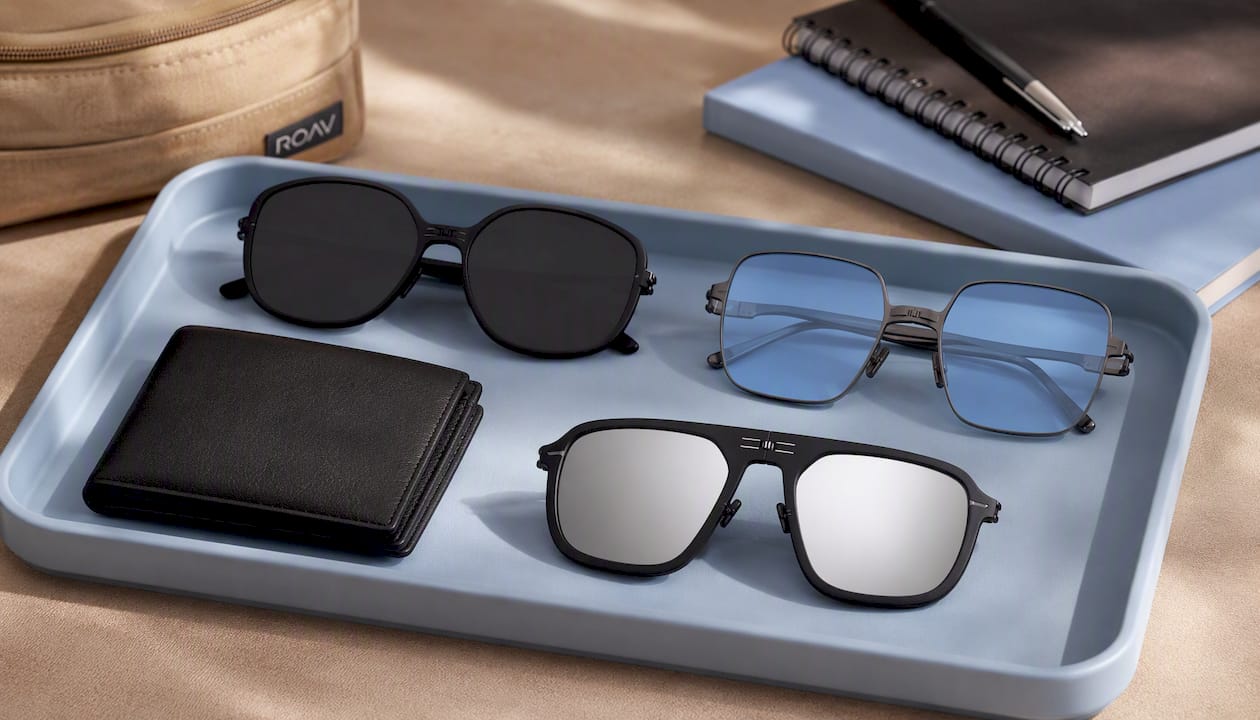
The BETTE Black | Dark-Grey is the closest thing to a wardrobe staple in the lineup: dark acetate frames with grey lenses that echo black leather cleanly, ideal for the commute-to-weekend crossover where you want one pair that works everywhere. The BRIGITTE Gunmetal | Light-Blue leans metal-toned, which pairs naturally with steel hardware on a cardholder or a grey-toned leather bifold if you’re following the tone-matching rule from earlier. The VIRGIL Black | Silver Mirror is the statement option, mirrored lenses that read sharp for a date night or a night out, while still folding down into the same compact footprint as the other two.
Every model ships with a protective pouch built for the fold, so lenses stay scratch-free next to your wallet instead of loose in a bag. Browse the full foldable sunglasses collection or the broader sunglasses range to compare frame shapes side by side, and if you wear a prescription, ROAV’s eyeglasses line applies the same folding hinge to everyday frames.
Sources
- How to Choose the Perfect Sunglasses Tint for You
- How to choose sunglasses | REI expert advice
- How to choose sunglass lenses | VSP
- Complete guide to men’s accessories | Man of Many
FAQ
Who should not wear polarized sunglasses?
Polarized lenses can make it harder to read LCD screens, some dashboard displays, and certain anti-glare devices, since they filter the same kind of light those screens emit. Pilots and some heavy-machinery operators are often advised against them for this reason. For most everyday drivers and outdoor use, polarization is a comfort benefit rather than a drawback.
How do I know which sunglasses to buy?
Start with fit and UV protection, not colour. Confirm the label says 100% UV or UV400, check that the frame passes the temple, bridge, and cheek clearance tests, then choose a tint that matches how you’ll actually use them, such as brown or amber for driving.
Is 100% UV protection or polarized better?
They solve different problems, so one isn’t strictly better than the other. UV protection is non-negotiable for eye health, while polarization is a glare-reduction feature that matters most for driving, water, and snow. Look for both, but never trade UV protection for polarization if you have to choose.
What should I avoid when buying sunglasses?
Avoid buying based on tint darkness alone. Very dark lenses without a confirmed UV filter can dilate your pupils and let in more UV light than no sunglasses at all. Also skip any pair with no UV labelling at all, and avoid oversized wallets that don’t match your actual card and cash count.
What does ROAV Eyewear sunglasses cost?
Pricing varies by model and isn’t listed as a flat figure, so current prices are best checked directly on the ROAV Eyewear sunglasses collection page. Each product page lists the exact price for that specific frame.