

Category 3 sunglasses let through roughly 8 to 18% of visible light, which puts them at the darker end of everyday eyewear and squarely in the zone for bright sunlight, beach days, and most daytime driving. That darkness rating has nothing to do with UV protection or polarisation, both of which are separate features worth checking on their own. If a pair is labelled Category 3, you can trust it for glare in strong sun, but you still need to confirm UV400 and polarisation separately.
TL;DR:
- Category 3 sunglasses block 8 to 18% of visible light, making them suitable for bright sunlight, beach days, and most daytime driving situations.
- They are classified according to ISO 12312-1 standards, which define VLT ranges and testing methods, not UV protection or polarization.
- UV400 protection and polarization are separate features; a lens can be dark and still lack UV filtering or polarization, so verify both labels independently.
- Polarized Category 3 lenses effectively reduce glare from water, snow, and asphalt, especially helpful for water sports, snow sports, and driving, but may impair LCD screen visibility.
- For everyday outdoor use in bright conditions, choose a well-fitting, coated pair with UV400 and consider polarisation when glare reduction is a priority.
Table of Contents
- What category 3 sunglasses meaning covers: VLT, the 0 to 4 scale, and ISO 12312-1
- Category 3 sunglasses vs UV400 and polarised lenses: what’s actually different
- When should you wear category 3 sunglasses?
- How to choose category 3 sunglasses: tint, polarisation, coatings and fit
- Which ROAV styles deliver on Category 3 protection?
- Who actually needs category 3 sunglasses, and how to decide fast
- Ready to buy? Two ROAV styles built for bright days
- Sources
What category 3 sunglasses meaning covers: VLT, the 0 to 4 scale, and ISO 12312-1
Visible light transmission, or VLT, measures how much light actually reaches your eyes through the lens. It’s expressed as a percentage: the lower the number, the darker the lens. Category 3 sits at 8 to 18% VLT, which is dark enough to cut glare off pavement and water without blacking out your view entirely.
The full scale runs from 0 to 4, and each step covers a distinct use case:
- Category 0: 80 to 100% VLT, essentially clear or barely tinted, suited to overcast days or indoor wear.
- Category 1: 43 to 80% VLT, light tint for low sun or hazy conditions.
- Category 2: 18 to 43% VLT, medium tint for typical outdoor daylight.
- Category 3: 8 to 18% VLT, dark tint built for bright sun and high glare.
- Category 4: 3 to 8% VLT, very dark, restricted to extreme brightness like glaciers or high-altitude snow.
This entire structure comes from ISO 12312-1, the international standard that governs how manufacturers test and label sunglasses for general use. It sets the VLT bands, the test methods labs use to confirm them, and the usage notes that show up on packaging. When you see “Cat 3” stamped inside a frame or printed on a swing tag, that number traces back to this standard, not a marketing team’s guess.
Category 3 sunglasses vs UV400 and polarised lenses: what’s actually different
Here’s where most buyers get tripped up: filter category and UV protection measure two completely different things. Category is about visible light, the brightness you perceive. UV400 is about ultraviolet radiation, which you can’t see or feel but which still damages your eyes over time. A lens can be Category 3 dark and offer poor UV blocking, or barely tinted and fully UV400 compliant. Lens.com’s glossary makes this distinction explicit: category measures VLT, UV400 measures ultraviolet blocking, and neither label guarantees the other.
Most quality Category 3 sunglasses do carry UV400 protection, since manufacturers building for outdoor performance rarely skip it. But “rarely” isn’t “always,” so check both labels rather than assuming one implies the other. UV exposure has been linked to cataract formation over years of accumulated exposure, which is exactly why the UV400 spec exists independently of tint darkness.
Polarisation adds a third, unrelated layer. It’s a filter that blocks horizontally scattered light, the kind that bounces off water, snow, and asphalt and creates that washed-out glare. Polarising film also happens to absorb visible light as a side effect, which is why polarised lenses are commonly manufactured in Category 3 tints. The two traits pair naturally, but a lens can be Category 3 without polarisation, and polarisation exists at other categories too.
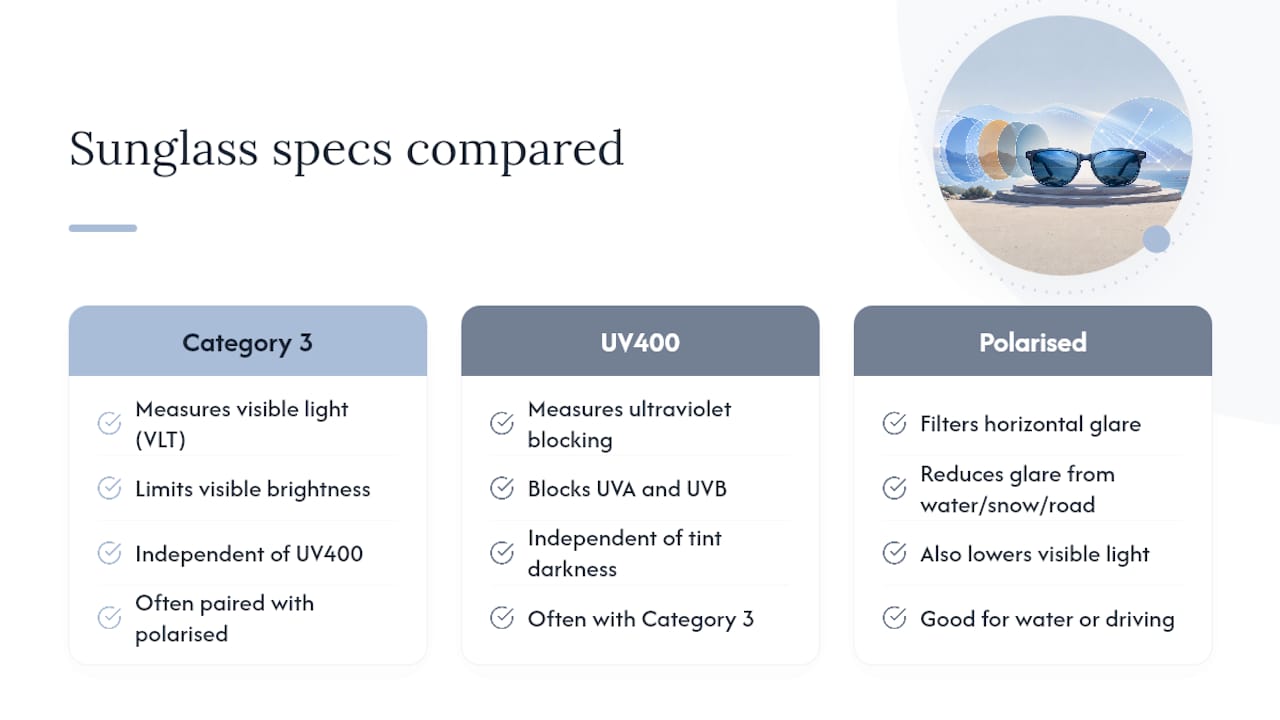
Pro Tip: If you spend time on water, snow, or behind the wheel, polarised Category 3 lenses are worth the extra cost. The glare cut is noticeable within the first few minutes of wear, especially on a sunlit highway or a boat deck.
You can dig deeper into how these two specs interact in our breakdown of UV protection versus polarised lenses.
When should you wear category 3 sunglasses?
Category 3 earns its reputation as the everyday workhorse of sun protection. It handles the situations most people actually face:
- Beach and open water: sun reflecting off sand and waves creates constant glare that a Category 2 lens won’t fully tame.
- Boating: similar water glare, sustained over hours, where eye fatigue builds fast without enough tint.
- Alpine hiking below the snowline: bright, unfiltered sun at elevation without the extreme reflectivity of glacier ice.
- Bright urban streets: glass, concrete, and chrome bounce light aggressively on clear days.
- Most daytime driving: enough darkness to cut windshield glare while keeping road signs and dashboard readouts legible.
Where Category 3 falls short is anything involving low light or darkness. It’s not built for night driving, dusk commutes, or overcast indoor transitions, where that much tint just makes it harder to see. Category 4 goes further still, dropping to 3 to 8% VLT for genuinely extreme brightness like high-altitude snowfields, but that level of darkness is too much for the road.
Motoring authorities generally treat Categories 0 through 3 as acceptable for driving, while Category 4 is frequently restricted or flagged as unsuitable for road use because it cuts too much light for safe reaction times. Environmental glare matters too: snow and open water intensify brightness well beyond what a plain sunny street produces, so someone with light sensitivity may lean toward the darker end of the Category 3 range even in conditions where others would be fine with Category 2.

How to choose category 3 sunglasses: tint, polarisation, coatings and fit
Lens colour changes how you perceive contrast, not just how dark things look. Grey tints keep colours true to life and are the safest neutral choice for driving. Brown and amber tints boost contrast against green and blue backgrounds, which is why they’re popular for hiking and fishing. Green tints split the difference, offering decent contrast without the colour shift that brown lenses introduce.
Polarisation is worth the trade-off for most outdoor use, but it comes with one caveat: polarised lenses can make LCD and LED screens hard to read, including some car dashboards, gas pumps, and ATM screens, because of how the polarising filter interacts with light emitted from those displays. If you rely heavily on a digital dashboard, test a pair before committing.
Beyond tint and polarisation, a few features separate a genuinely durable pair from a disposable one:
- UV400 rating, checked separately from the Category 3 label, as covered above.
- Anti-scratch coating, since Category 3 lenses see heavy outdoor use and scuff easily without it.
- Anti-reflective coating on the inside surface, which cuts the ghosting glare that bounces back off your own eyes.
- Frame fit, since even a correctly rated lens loses effectiveness if light leaks in around loose temples.
Industry voices in lens manufacturing describe Category 3 as the “sweet spot” for consumers precisely because it balances that protection with everyday usability better than the categories on either side of it. Before buying, check that the product listing references ISO 12312-1 labelling, and look at the retailer’s return policy in case the fit or tint isn’t right once you’re outdoors. Our guide to choosing travel sunglasses walks through fit considerations in more detail.
Which ROAV styles deliver on Category 3 protection?
Roaveyewear builds its foldable frames around a patented micro hinge that collapses the temple arms flat without the bulk of a standard hard case, a detail that matters once you’re deciding which pair to actually carry every day. Every lens ships with UV protection, and the brand has built a base of over 100,000 customers who rely on that combination of compact storage and daily-use durability.
Two current styles fit the Category 3 profile discussed throughout this guide:
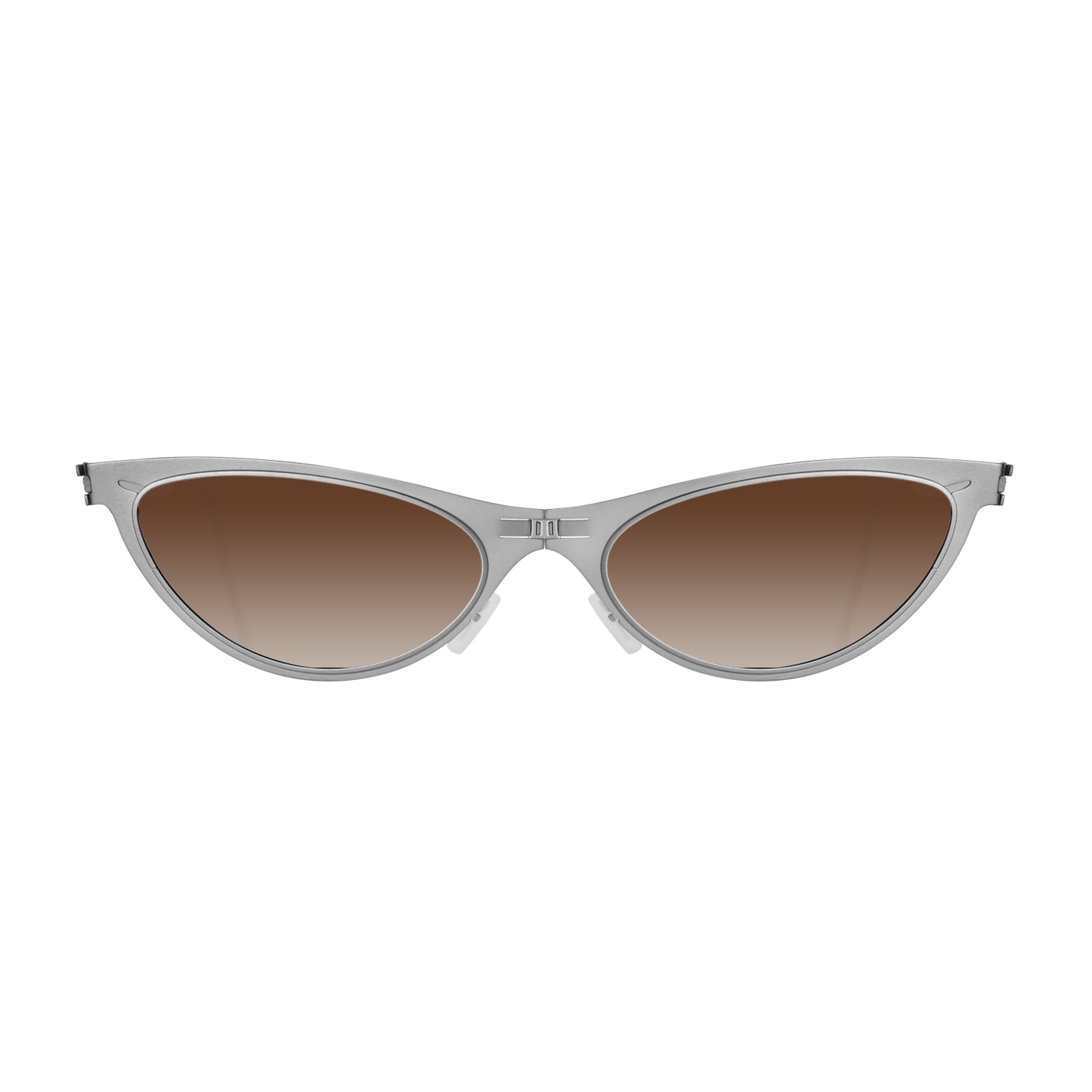
- ATHENA Gunmetal | Brown-Gradient: a brown-gradient tint that boosts contrast in bright outdoor light, paired with a gunmetal frame built for everyday carry.
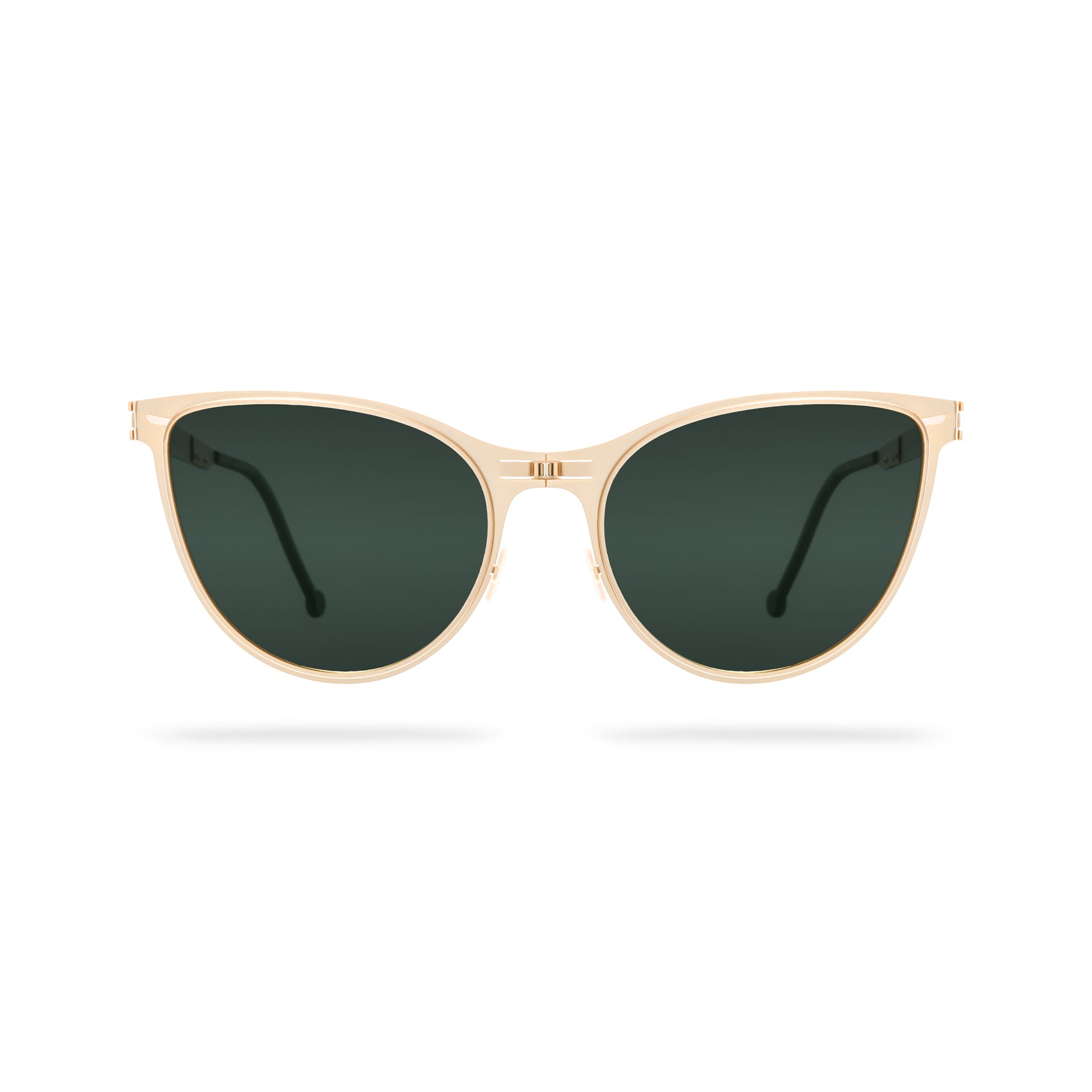
- SCARLETT Gold | G15: a G15 tint, the classic neutral grey-green favoured for true colour perception in strong sun, on a gold-tone frame.
Both styles fold down small enough for a jacket pocket, which matters if you’ve ever left a bulky pair on a restaurant table or crushed one at the bottom of a bag.
Who actually needs category 3 sunglasses, and how to decide fast
Travellers and daily drivers get the most value out of Category 3, simply because they’re the ones moving between bright environments most often. Outdoor enthusiasts, hikers, boaters, and beach regulars sit right behind them. If your day involves sustained bright sun rather than brief exposure, Category 3 is the sensible default rather than a splurge.
My rule of thumb: if you’re squinting outdoors on a clear day more than a couple of times a week, go Category 3 with UV400 and skip anything lighter. Save Category 4 for snowfields and glaciers, not the daily commute. The category number tells you how dark the lens is, nothing more. UV400 and polarisation are the features that actually protect your eyes and cut glare, so check all three before you buy.
— Ghali
Ready to buy? Two ROAV styles built for bright days
Roaveyewear’s whole design philosophy solves a problem most sunglasses ignore: a great Category 3 lens does you no good if the frame is too bulky to actually bring along. The patented micro hinge folds each pair down to pocket size, so you’re not choosing between proper glare protection and something you’ll actually carry to the beach, the trailhead, or the airport gate.
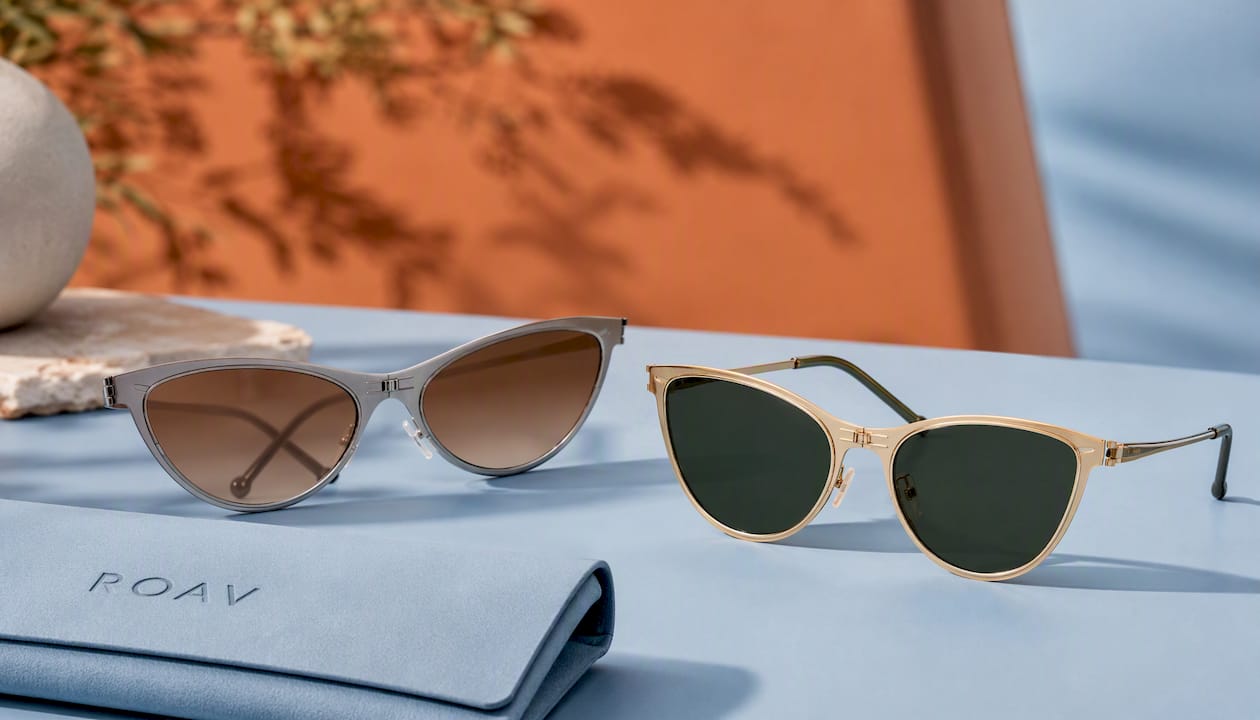
The ATHENA Gunmetal | Brown-Gradient pairs a contrast-boosting brown-gradient tint with a frame built for daily wear, ideal if you want punchier detail on hikes or bright city streets. The SCARLETT Gold | G15 uses the classic G15 tint for true-to-life colour, a solid pick if you want one dependable pair for driving, beach days, and everything in between. Every ROAV order ships with UV protection built in, a waterproof pouch, and a straightforward fit and returns policy if the frame or tint isn’t quite right once you’ve worn it outdoors. Browse either page, check your frame size against the fit guide, and place your order directly through the site.
Sources
- Decoding filter categories and visible light transmission — ZEISS Sunlens
- Driving with sunglasses – what are the rules? | RAC Drive