

Choose sunglasses by the three-number millimetre code (lens, bridge, temple) stamped inside the arm, calculate the frame width as (2 × lens width) + bridge width, then match that number to your temple-to-temple face measurement. Aim for a difference within a small margin of your face width; greater deviations often look pinched or oversized. Grab a soft tape, a ruler, or a credit card, and you can measure yourself in under two minutes.
TL;DR:
- Choosing sunglasses by millimeter measurements ensures a more precise fit than standard size labels, reducing discomfort and glare issues.
- Frame width should closely match your face measurement within plus or minus 2 millimeters to avoid pinching, slipping, or light gaps.
- Accurate face measurement and understanding your pupillary distance are key to selecting sunglasses with proper coverage and optical alignment.
- Popular Roaveyewear frames come in specific dimensions that can be calculated and matched precisely, improving overall comfort and protection.
- Verifying lens, bridge, and temple dimensions on the product page minimizes the risk of ordering mismatched frames that do not fit your face shape or size.
Table of Contents
- What do the three sunglass measurement numbers mean?
- How do you measure your face for sunglasses?
- How do you convert your measurements into a sunglasses size?
- Why do your sunglasses pinch, slip, or let in light?
- Turn your favourite pair into your permanent size benchmark
- Why does sunglass fit actually matter, and how does frame design affect it?
- How do you determine your face shape, and does it actually matter?
- A short checklist before you buy
- Try these ROAV styles using your own numbers
- Sources
What do the three sunglass measurement numbers mean?
Flip open any pair of sunglasses and check the inside of the temple arm. You’ll usually find a stamp like 52-18-140, and each number corresponds to a specific dimension of the frame.
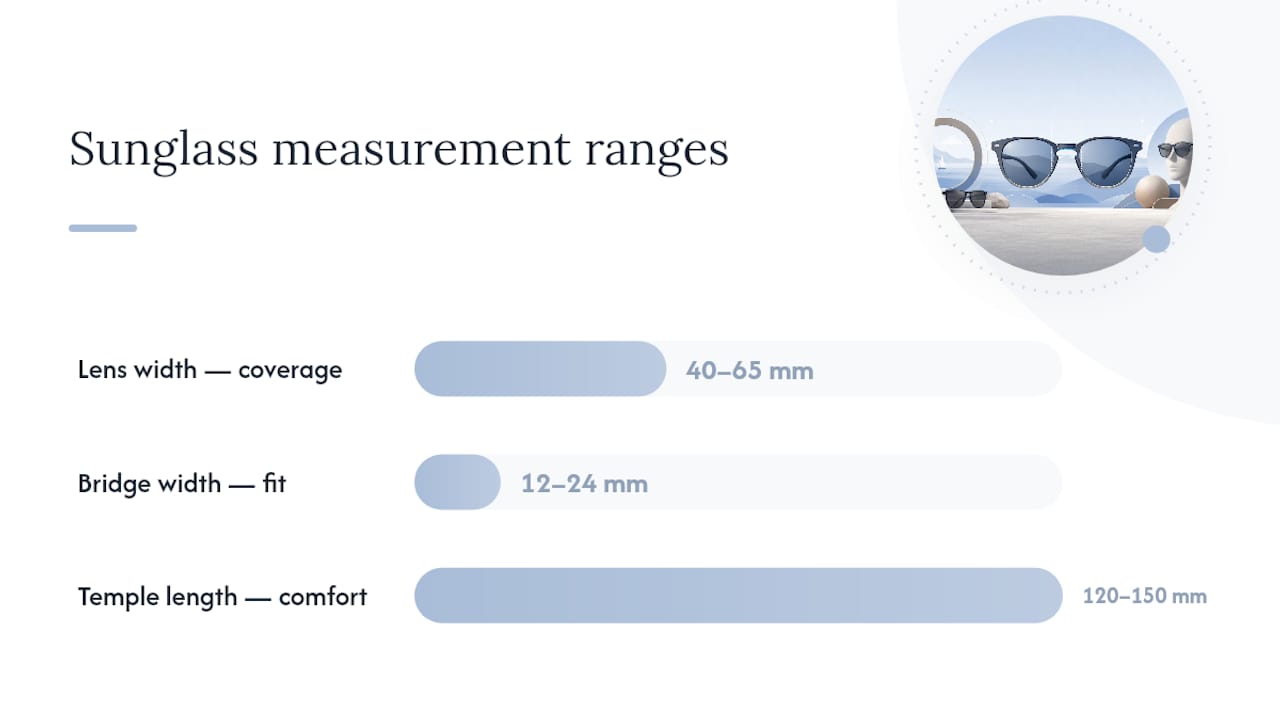
- Lens width (first number): the horizontal width of one lens, typically 40–65 mm.
- Bridge width (second number): the gap between the lenses, sitting on your nose, typically 12–24 mm.
- Temple length (third number): the arm length from hinge to tip, typically 120–150 mm, clustering around 135–145 mm for most adults.
There’s a fourth figure worth knowing even though it rarely appears in the stamp: lens height, the vertical size of the lens. It matters most if you wear progressives, since a shallow lens can cut off the reading corridor.
Each number pulls its own weight. Lens width and bridge width together decide how wide the frame sits on your face and how much UV coverage you get at the edges. Temple length decides whether the arms grip your head comfortably or ride up over your ears. Get the bridge wrong and you’ll feel pinching within an hour. Get the temple wrong and the glasses slide the moment you look down.
How do you measure your face for sunglasses?
Your face width is the one number no frame stamp can give you, so you have to take it yourself. Here’s a repeatable method.
- Stand in front of a mirror, or better, have a friend do the measuring for you.
- Hold a flexible tape or ruler across the widest part of your face, usually just above the cheekbones, temple to temple.
- Measure twice and average the two readings. A single measurement is easy to skew by a few millimetres.
- If you’re ordering prescription sunglasses, also measure your pupillary distance (PD), the distance between the centres of your pupils. It determines where the optical centre of each lens sits, and getting it wrong causes eye strain even in an otherwise well-fitting frame.
- No tape on hand? A standard credit card is 85.6 mm long. Line it up against your face in the mirror as a rough reference point.
If you already own a pair that fits well, skip the guesswork entirely and read the three-number code stamped inside the arm. That code is the single most reliable benchmark you’ll find, more accurate than any online quiz.
Pro Tip: Write your face width, PD, and the three numbers from your best-fitting pair on one note in your phone. Every future purchase becomes a thirty-second comparison instead of a gamble.
How do you convert your measurements into a sunglasses size?
Once you have your face width, the math is simple: frame width = (2 × lens width) + bridge width. Add both lens widths and the bridge together, and you get the total horizontal span of the frame. Compare that number to your temple-to-temple measurement.
- A frame within ±2 mm of your face width will generally sit proportionally. It will neither swallow your face nor squeeze your temples.
- A gap past 5 mm in either direction usually looks off, and you’ll feel it in comfort long before you notice it in the mirror.
- As a rough starting point: narrower faces tend to suit smaller lens widths, medium faces an intermediate range, and wider faces larger sizes.
When you’re stuck between two sizes, lean larger. Bigger lenses cover more of the eye’s periphery, which matters for UV protection, not just style. For prescription orders, remember that lens width and PD are separate numbers. A frame can measure perfectly on your face and still need a custom PD entry so the optical centres land correctly. And if progressives are involved, confirm the lens height clears roughly 28 to 30 mm so the lab doesn’t have to decentre the optics.
Why do your sunglasses pinch, slip, or let in light?
Every common fit complaint traces back to one of the three numbers being off, which means every complaint has a specific fix.
- Pinching at the temples or nose: the bridge is too narrow for your nose bridge. Size up in bridge width or ask an optician about nose pad adjustments.
- Sliding down constantly: either the bridge is too wide or the temple length is wrong for your head. A shorter temple with a gentle curve behind the ear often solves this without replacing the whole frame.
- Light leaking in from the sides: usually a flat frame profile or a lens width that’s too narrow for your face. A wraparound or slightly curved style closes that gap without changing the mm numbers at all.
- Sore spots behind the ears after a few hours: a temple that’s too long for your head shape, riding past the natural bend point.
Most of these fixes are minor: a quick bend at an optician’s counter, a nose pad swap, or simply choosing a curved style over a flat one. If a frame is consistently uncomfortable after adjustment, the underlying millimetre numbers are wrong for your face, not the style.
Pro Tip: If you’re torn between a flat frame and a wraparound in the same lens width, the wraparound will almost always block more side glare, which matters more in summer driving conditions than a few millimetres of lens width.
Turn your favourite pair into your permanent size benchmark
Once you’ve found a pair that actually fits, that frame becomes your reference for every future purchase; here’s how to use it properly.
- Find the three-number stamp inside the temple arm (near the hinge, sometimes under the bridge).
- Calculate its frame width using the same formula: (2 × lens width) + bridge width.
- Compare that number against any new frame you’re considering, ignoring the S/M/L label entirely. Sizing labels aren’t standardized across brands, so a “medium” from one label means nothing next to a “medium” from another.
- Keep a running note of your numbers, your face width, and your PD if you wear prescriptions.
That short list turns every future purchase into a quick numbers check instead of a returns gamble.
Why does sunglass fit actually matter, and how does frame design affect it?
Fit isn’t cosmetic. A frame that sits too wide lets UV rays in from the sides; a frame that’s too tight causes headaches and pressure marks within an hour of wear. The three-number system exists precisely because “small, medium, large” can’t capture that kind of precision.
Foldable frames add one more wrinkle worth knowing. A hinge that folds needs slightly more engineering tolerance in the temple to keep its grip consistent after repeated folding, which is why Roaveyewear built its frames around a patented micro hinge designed to hold its shape through daily folding and unfolding. Over 100,000 customers have relied on that hinge for travel-heavy use, and every pair carries polarized UV protection, so getting the width right isn’t just about comfort, it’s about making sure the coverage actually does its job.
Before ordering online, check that a seller lists all three mm numbers on the product page. If a retailer can’t produce lens, bridge, and temple dimensions on request, treat that as a warning sign rather than a minor omission.
- Confirm lens, bridge, and temple numbers are listed, not just a size label.
- Check whether the temple has any flex or spring hinge for a better range of head sizes.
- Compare the calculated frame width against your own face measurement before adding to cart.
How do you determine your face shape, and does it actually matter?
Face shape matters less than most style guides suggest, but it’s still worth five minutes to figure out, since it narrows your starting point before you even look at millimetres. Stand in front of a mirror and trace the outline of your face with a dry-erase marker or lipstick, then step back and compare the shape to a few basic categories: oval, round, square, heart, and diamond are the common ones.

A round or square face, wider through the cheeks or jaw with minimal length variation, tends to look most balanced with frames that add some angularity, rather than perfectly round lenses that echo the same shape. A longer, narrower oval face has more flexibility and can usually wear most lens shapes without looking off. A heart-shaped face, wider at the forehead and narrower at the chin, often pairs well with frames that are slightly wider at the bottom or have detailing that draws the eye downward, balancing out the forehead.
Here’s the catch: face shape tells you which lens shape might look flattering, but it tells you nothing about which size will fit. A round face and an oval face can have identical temple-to-temple measurements. Two people with the same “heart-shaped” face might need lens widths ten millimetres apart depending on bone structure. Treat face shape as a style filter you apply after you’ve already narrowed down your size using the millimetre numbers, never before. Skipping straight to shape and skipping the measurement step is how most online sunglasses purchases end up back in a return box.
A short checklist before you buy
Measure your face width, note the three numbers on any frame you’re eyeing, run the frame-width formula, check your PD if it’s a prescription order, and size up when you’re stuck between two options. The two mistakes I see constantly: trusting a “medium” label across brands, and ignoring temple length until the glasses are already sliding down your nose an hour into wearing them.
— Ghali
Try these ROAV styles using your own numbers
Every Roaveyewear product page lists the exact lens, bridge, and temple dimensions, so you can run the frame-width formula before you buy instead of guessing and hoping. That’s the whole point of shopping by millimetres rather than by S/M/L.
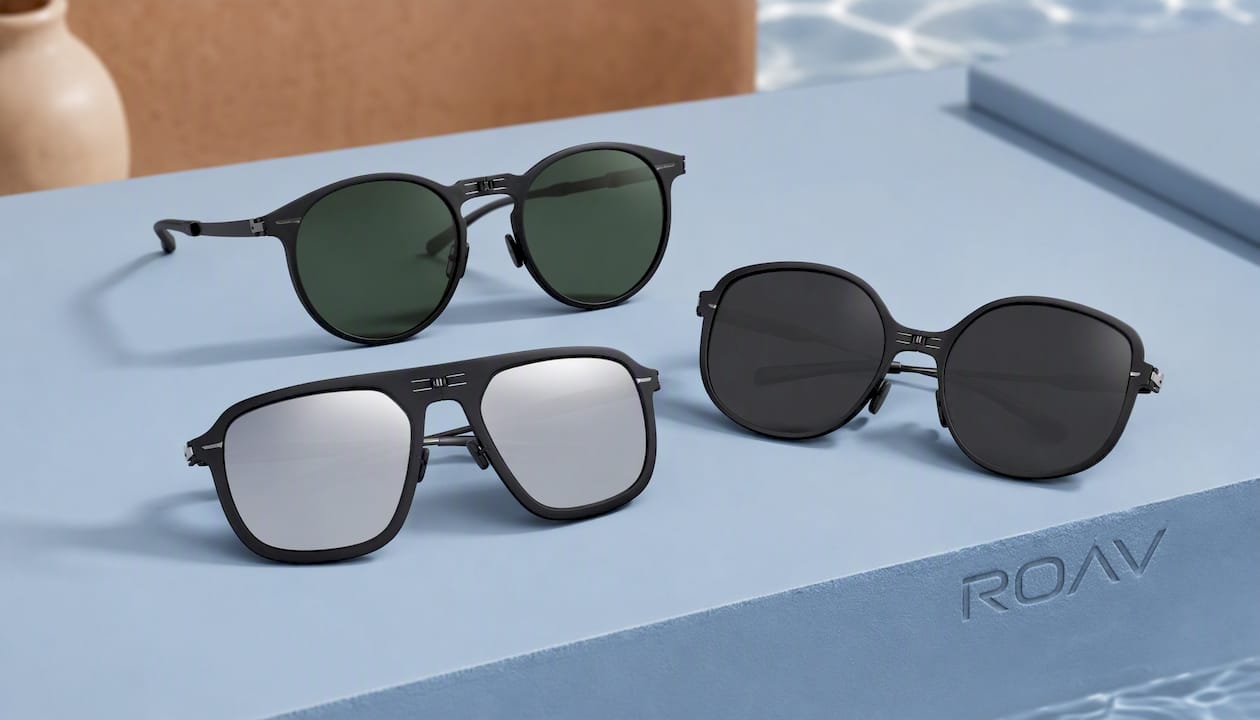
If your face width lands on the narrower side, the RIVIERA Black | G15 tends to sit well thanks to its tighter lens proportions. Medium face widths generally suit the VIRGIL Black | Silver Mirror, which balances lens width and bridge width for a proportional look across a broad range of face sizes. Wider faces, or anyone who prefers a bolder frame, should check the BETTE Black | Dark-Grey, built with a wider lens span for extra coverage.
All three fold flat with Roaveyewear’s patented micro hinge, so once you’ve found your size, the same pair fits in a jacket pocket without losing shape. If a pair doesn’t sit right once it arrives, reach out through customer support to sort out an exchange for a different size using the same mm comparison method. Check the product pages directly, filter by the dimensions you calculated, and order the size that actually matches your numbers.
Sources
- Measure your face for perfect sunglass fit - Lensmart
- How to Measure Sunglasses Size: The Complete Fit Guide
- How do I know my sunglasses size? - Eluno