

Polycarbonate wins for safety, weight, and built-in UV protection, which is why it dominates sports eyewear and kids’ glasses. Glass wins for optical clarity and scratch resistance, which matters most for low-impact, everyday wear where sharp vision counts more than shatterproofing. Coatings narrow both gaps somewhat, and a strong prescription tends to push the decision toward polycarbonate regardless of your other preferences.
TL;DR:
- Polycarbonate is the safer, impact-resistant choice for sports, kids, and active lifestyles, with inherent UV protection built into the material.
- Glass offers better optical clarity and scratch resistance but is heavier, more fragile, and requires coatings for UV protection that can degrade over time.
- The Abbe value reveals that glass significantly reduces chromatic aberration compared to polycarbonate, but most everyday wearers do not notice this difference.
- Temperature extremes affect each material differently: glass tolerates heat better, while polycarbonate remains impact-resistant in cold conditions.
- Environmental impact is limited for both due to recycling challenges, emphasizing the importance of durability for reducing overall waste.
Table of Contents
- Glass vs polycarbonate lenses: what optical clarity actually looks like
- Impact resistance and UV protection: the safety case for polycarbonate
- Scratch resistance of lenses and where coatings fit in
- Weight, thickness, and how each material fits your frames
- Best lenses for glasses by activity and prescription strength
- How ROAV Eyewear approaches lens selection for foldable frames
- Thermal resistance: how heat and cold affect each lens
- Chemical resistance and how to clean each lens type
- Long-term durability: how each material ages
- Environmental impact and recyclability of glass and polycarbonate
- The trade off nobody frames honestly
- ROAV product spotlight and a quick buying checklist
- Sources
- FAQ
Glass vs polycarbonate lenses: what optical clarity actually looks like
Clarity comes down to a number most shoppers never hear about: the Abbe value. It measures how much a lens material scatters different wavelengths of light as they pass through, and a low score means more chromatic aberration, the faint colour fringing you sometimes see around high-contrast edges. Glass typically scores around 58 to 59 on the Abbe scale, while polycarbonate scores roughly 30, a gap wide enough to matter in specific situations.
Who actually notices this in daily life:
- People with strong prescriptions, where light bends more and aberration becomes more visible
- Anyone doing precision work like detailed reading, drafting, or fine craftsmanship
- Wearers sensitive to peripheral distortion, especially in wraparound sunglass frames
For most casual wearers, though, the difference is subtle enough to go unnoticed day to day unless the prescription is significant. A good anti-reflective coating and a higher-index lens formulation can also sharpen perceived clarity in polycarbonate, closing part of the gap without changing the base material.
Impact resistance and UV protection: the safety case for polycarbonate
Polycarbonate was engineered for high-impact use, and it shows. Glass can shatter into sharp shards on hard impact, while polycarbonate flexes and absorbs the blow, which is why optometry guidance frequently recommends polycarbonate or Trivex for children and for sports.
Three practical consequences follow from that:
- Contact sports and cycling call for polycarbonate almost by default, since a cracked glass lens near the eye is a real injury risk.
- Kids’ eyewear benefits from the same logic. Children drop, throw, and sit on their glasses more than adults do.
- UV protection differs structurally, not just in degree. Polycarbonate blocks UV400 radiation inherently, built into the molecular structure, while glass needs a UV-blocking coating applied during manufacturing to reach the same standard.
That last point matters more than most buyers realize. A coating can wear thin or get scratched away over years of use; a property built into the material itself doesn’t degrade the same way. If you’re weighing UV blocking against polarization for your next pair, this is where that distinction starts to matter.
Scratch resistance of lenses and where coatings fit in
Glass is naturally harder than polycarbonate, and that hardness shows up directly in day-to-day durability. Left uncoated, glass resists everyday scratches better than polycarbonate, which is one reason some wearers still choose it for low-risk situations like desk work or driving.
Polycarbonate needs a hard coat to compete at all, and even then, it usually doesn’t fully close the gap over years of wear.
- Uncoated polycarbonate scratches more easily than glass, sometimes within months of regular use
- A quality hard coat extends usable life significantly but doesn’t match glass long-term
- Glass eventually chips rather than scratches, a different failure mode worth knowing about
- Surface hardness principles that protect scratch-resistant watch crystals follow similar physics: harder materials resist marring, softer ones need a protective layer
Pro Tip: Store lenses in a hard case rather than a soft pouch when you’re not wearing them. Grit trapped in fabric is the most common cause of fine scratches on both materials, not accidental drops.
Weight, thickness, and how each material fits your frames
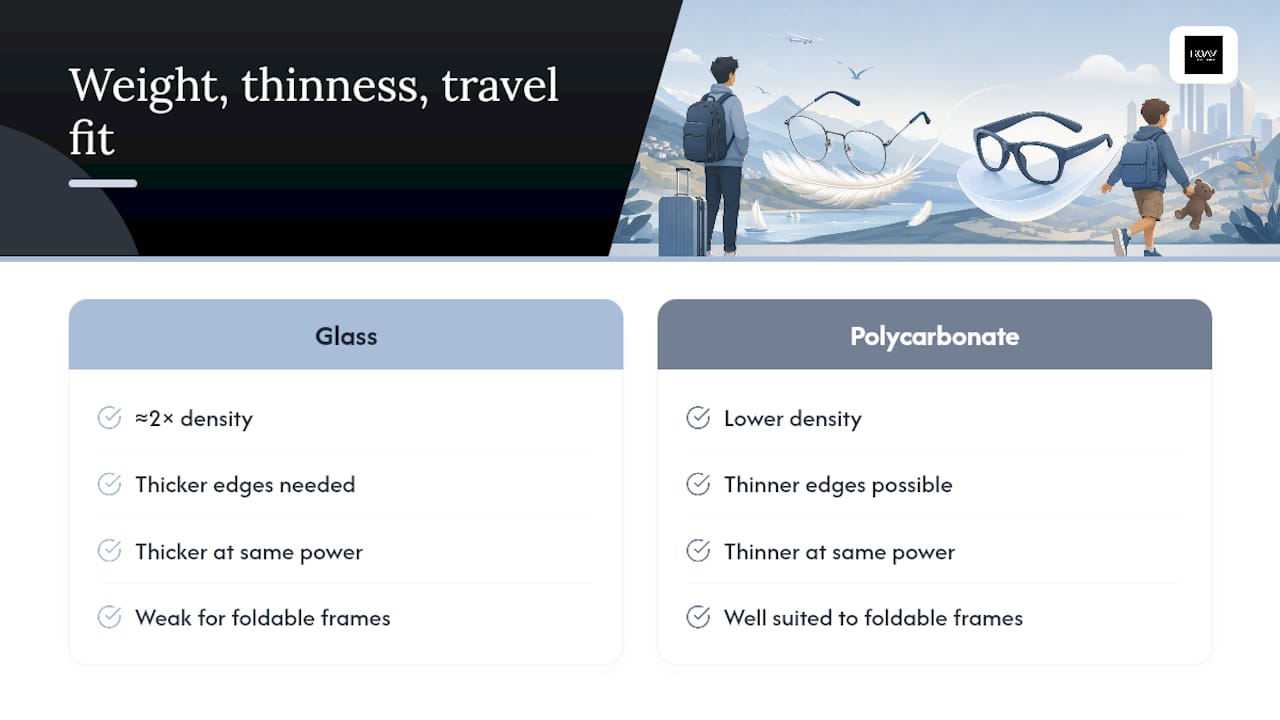
Glass is roughly twice as dense as polycarbonate, and that weight adds up fast across a full day of wear. Rimless and semi-rimless frames suffer the most, since glass lenses need thicker edges to stay structurally sound, which then adds bulk exactly where designers wanted it thin.
Polycarbonate’s higher refractive index means it can be ground thinner than glass at the same optical power, a real advantage for anyone with a moderate to strong prescription. That thinness also plays well with foldable and travel-friendly frames, where every gram and millimetre affects how compact the final fold becomes.
Best lenses for glasses by activity and prescription strength
The right call depends less on personal preference and more on what you’re actually doing while wearing them.
- Sports, cycling, and kids’ glasses: polycarbonate, without much debate, given the impact and UV advantages already covered
- High prescriptions: polycarbonate or a high-index plastic, since glass becomes impractical as dioptres increase, adding weight and thickness that strong lenses already struggle with
- Low-impact, clarity-focused wear: glass, if scratch resistance and pure optical fidelity outrank weight concerns
- Driving and everyday fashion sunglasses: either works, though polycarbonate’s ease of tinting and lower manufacturing cost explains why it dominates the non-prescription sunglass market
Cost tracks that same pattern. Polycarbonate is generally cheaper to produce and more widely available across styles, while glass often carries a premium tied to its weight, fragility during manufacturing, and narrower niche among clarity-focused buyers. Trivex sits between the two on several fronts and is worth asking about if your optician stocks it.
How ROAV Eyewear approaches lens selection for foldable frames
Foldable eyewear adds a design constraint most lens comparisons ignore: the lens has to survive the mechanical stress of folding, unfolding, and living in a pocket or bag. That pushes the priority list toward lightweight, impact-tolerant materials with dependable UV protection built in, which is exactly why ROAV Eyewear designs around lenses suited to active, on-the-go wear rather than static desk use.
Frames intended for travel and daily carry benefit from that same lightness when it comes to comfort during long stretches of wear, and the same qualities that make a lens forgiving in a folded, portable frame also make it forgiving on an active weekend.
Thermal resistance: how heat and cold affect each lens
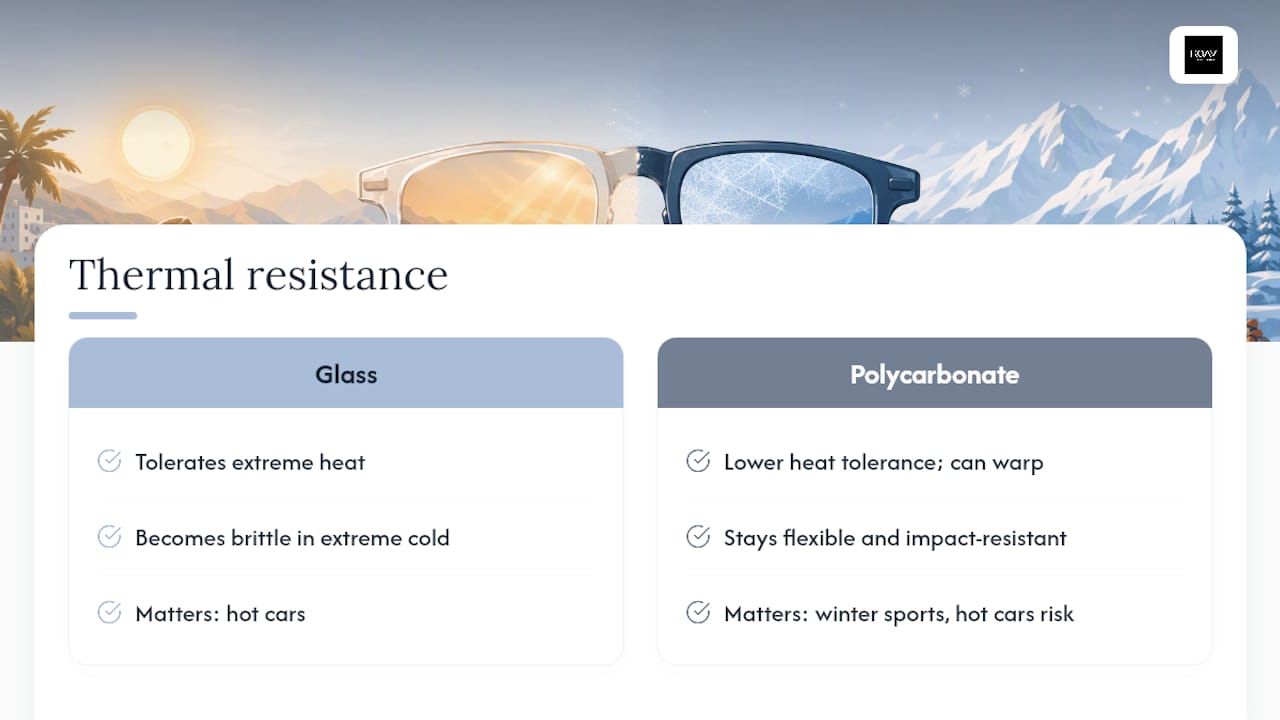
Temperature swings affect these two materials differently, and it’s a factor most buying guides skip. Polycarbonate has a lower melting point than glass and can soften or warp under extreme, sustained heat, the kind you’d get from leaving sunglasses on a dashboard in direct summer sun for hours. Glass tolerates high heat far better, since it’s chemically stable across a much wider temperature range before any structural change occurs.
Cold behaves differently. Polycarbonate stays flexible and impact-resistant even in freezing conditions, which is part of why it remains the standard for winter sports eyewear. Glass, by contrast, can become more brittle in extreme cold, and a hard impact on a frigid ski slope is a worse scenario for glass than for polycarbonate on both counts, temperature and impact combined.
For most wearers, this rarely becomes a real issue. Cars parked in summer heat and winter sports are the two scenarios where it actually matters. If you regularly leave sunglasses in a hot vehicle, polycarbonate’s slightly lower heat tolerance is worth knowing, though everyday warmth from sunlight or body heat causes no meaningful damage to either material. The practical takeaway: extreme, sustained heat favours glass; extreme cold combined with impact risk favours polycarbonate.
Chemical resistance and how to clean each lens type
Cleaning habits matter more than most people assume, and the two materials react differently to common household chemicals. Polycarbonate is more vulnerable to solvents. Acetone, ammonia-based glass cleaners, and some sunscreen ingredients can cloud, craze, or degrade its surface coating over time, particularly the anti-reflective and anti-scratch layers applied during manufacturing.
Glass tolerates a broader range of cleaning agents without surface damage, since its chemical structure is far less reactive. That said, glass isn’t immune to problems. Harsh abrasives can still scuff it, and any coating applied to glass, including UV treatments, follows the same vulnerability rules as coatings on polycarbonate.
Practical maintenance advice applies to both materials equally:
- Use a lens-specific cleaning solution or plain water with a microfibre cloth, never household glass cleaner
- Avoid paper towels or tissues, which contain wood fibres that can create fine scratches on either surface
- Rinse off sunscreen, salt water, or chlorine as soon as practical, since residue left to dry is more damaging than the exposure itself
Neither material needs special products beyond a basic lens cleaner and a soft cloth. The bigger risk with both comes from what wearers do out of habit, wiping lenses on a shirt hem, tossing them uncased into a bag, rather than from the chemistry of the lens itself.
Long-term durability: how each material ages
Age changes these lenses in different ways, and neither one stays exactly as it was on day one. Polycarbonate’s biggest long-term weakness is coating degradation. The hard coat that gives it scratch resistance thins with years of wiping and handling, and once it wears through, the underlying polycarbonate scratches more readily than it did when new. UV-blocking properties built into the base polycarbonate don’t fade, though, since that protection is structural rather than a surface treatment.
Glass ages more predictably from a pure optical standpoint. It doesn’t cloud, craze, or lose clarity over time the way a worn polycarbonate coating can. Its long-term risk is mechanical rather than chemical: a glass lens that survives ten years of gentle handling can still shatter on one bad drop that a polycarbonate lens would have shrugged off entirely.
For frequent, active wearers, that trade-off tends to favour polycarbonate over the years, since a slightly scratched lens is a cosmetic annoyance while a shattered lens is a safety event. For wearers who baby their glasses and prioritize consistent optical quality, glass often ages more gracefully because there’s no coating layer to wear down in the first place.
Environmental impact and recyclability of glass and polycarbonate
Neither material is particularly easy to recycle through standard municipal programs, and this is a genuine weak spot for both. Polycarbonate is a petroleum-based plastic, and most curbside recycling systems aren’t set up to process small optical-grade plastic pieces mixed with metal hinges and coatings. Glass, in theory, is more recyclable since raw glass can be reprocessed indefinitely, but optical glass is coated and often bonded to frame components in ways that make separation impractical for typical recycling streams.
Manufacturing footprint tells a similar story from a different angle. Glass lens production requires higher energy input due to the melting and grinding processes involved, while polycarbonate manufacturing is generally less energy-intensive but relies on petrochemical feedstocks.
The most meaningful environmental lever for either material isn’t the lens itself. It’s how long the eyewear stays in use. A durable, well-maintained pair of glasses, regardless of lens material, does more for its environmental footprint by lasting five or ten years than any recycling program currently available for either glass or polycarbonate optical waste.
The trade off nobody frames honestly
Most lens comparisons treat this like a scientific tie that comes down to personal taste, and that framing undersells what the data actually shows. If safety and durability under real-world impact are on the table at all, sports, kids, active travel, polycarbonate isn’t a lifestyle preference. It’s the safer default, full stop, and the built-in UV protection makes the case stronger.
Where I think conventional advice falls short is treating glass as the automatic “premium” choice. Clarity is real and measurable, but the Abbe value gap matters far less to most everyday wearers than marketing suggests. Unless your prescription is strong or you do genuinely precision-dependent work, you’re unlikely to notice the chromatic aberration difference in normal use.
What should drive the decision is honest self-assessment about how you actually live. Do you travel, hike, commute by bike, or have kids underfoot? Weight, impact resistance, and built-in UV protection should outrank marginal optical gains. Reserve glass for situations where your glasses sit quietly on a desk and rarely face real-world risk.
— Thomas
ROAV product spotlight and a quick buying checklist
ROAV Eyewear builds every frame around the same idea: eyewear that folds down small shouldn’t mean settling for cheap-feeling lenses or compromised UV protection. Each model below targets a slightly different priority, so matching your lifestyle to the right one takes a minute, not an afternoon.
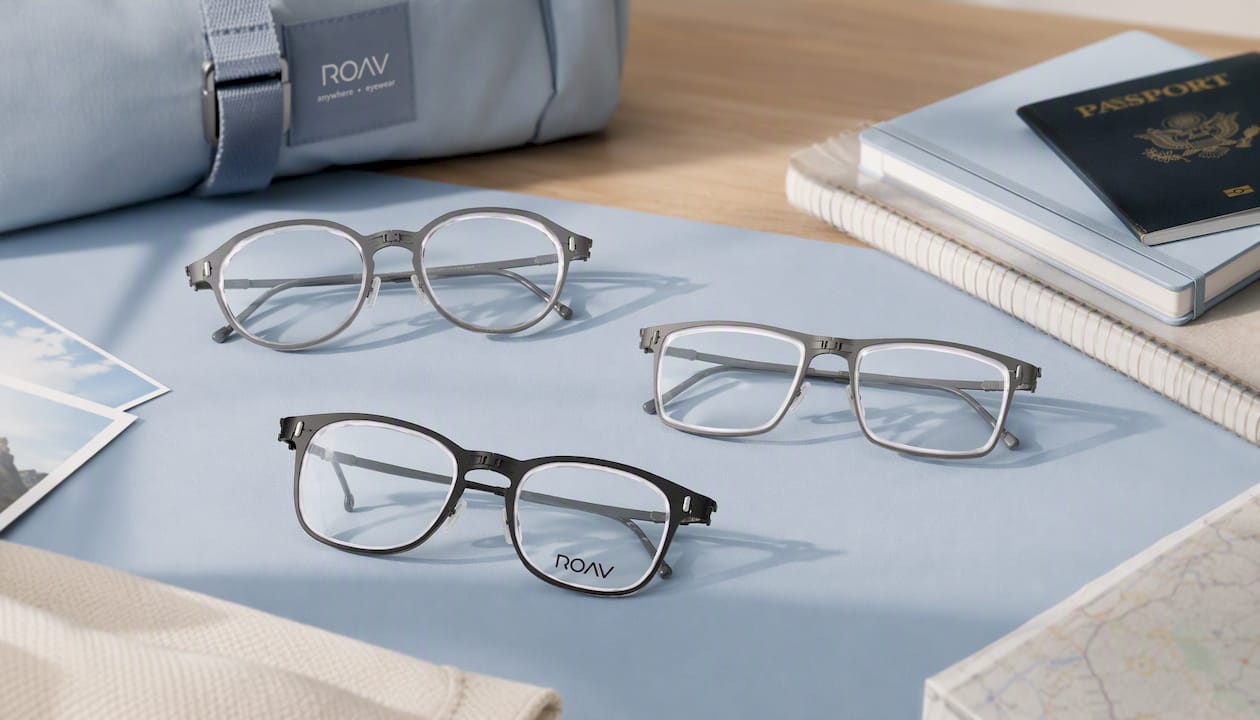
The ACE Gunmetal+Crystal | Clear suits readers who want a clean, minimal frame for everyday carry, travel days, and commuting where lightweight comfort matters more than anything else. The DEVON Gunmetal+Crystal | Clear fits wearers after a slightly bolder look without giving up the fold-flat convenience, a solid middle ground between style and function. The DALLAS Black+Crystal | Clear works best as a genuine everyday all-rounder, versatile enough for both active weekends and office wear.
Before you buy, run through this quick checklist: confirm the lens type suits your main activity, ask about anti-scratch or anti-reflective coatings if you wear your glasses daily, and check that the frame’s fold mechanism fits comfortably in your pocket or bag routine. Browse the full ROAV Eyewear lineup to compare styles side by side.
Sources
- Is Glass Or Polycarbonate Better For Sunglasses - ScienceInsights
- Glass vs. Polycarbonate Lenses – Fuse Lenses
FAQ
Is it worth paying more for glass instead of polycarbonate sunglasses?
Only if optical clarity and scratch resistance outrank weight and impact safety for how you actually use your glasses. For sports, travel, or kids, polycarbonate’s safety and UV advantages generally outweigh the clarity gap.
What are the disadvantages of polycarbonate lenses?
Polycarbonate has a lower Abbe value than glass, around 30 versus glass’s 58 to 59, meaning more chromatic aberration, and it scratches more easily without a hard coat.
Which is better, polycarbonate or glass?
Neither is universally better. Polycarbonate wins on impact resistance, weight, and built-in UV protection, while glass wins on optical clarity and natural scratch resistance, so the right choice depends on your activity and prescription.
Do you still need sunglasses with polycarbonate lenses?
Yes. Polycarbonate blocks UV400 radiation inherently, but sunglasses also need proper tinting or polarization for glare reduction, which UV blocking alone doesn’t provide.