

Choose polarization when reflected glare off water, pavement, or a windshield is the problem you’re solving. Choose a mirror finish when overall brightness or a reflective look matters more. Plenty of lenses do both, so check the spec sheet for “polarized” and “mirrored” listed separately, along with the UV rating.
TL;DR:
- Polarized lenses effectively block horizontal glare from surfaces like water and roads, providing sharper contrast but can interfere with some LCD screens.
- Mirrored lenses reduce overall brightness with a reflective coating that scratches more easily, and they do not filter glare from specific directions.
- Check that sunglasses explicitly list both polarized and mirrored features separately, along with UV400 or full UVA/UVB protection, for proper glare and brightness control.
- For driving or water activities, polarized lenses are generally the top choice, while a mirror finish is better suited for bright, reflective snow or outdoor environments.
- Combining both features in a single pair is ideal for versatile outdoor use, with each feature addressing specific light problems.
Table of Contents
- What are mirrored lenses, and how does the coating work?
- What are polarized lenses, and how does polarization actually work?
- Mirrored vs polarized: the head-to-head
- Which lens fits your activity?
- Your buying checklist before you pay
- How ROAV Eyewear labels polarization and mirror finishes
- Why the “just get mirrored, they look cool” advice falls short
- Foldable styles built around this exact checklist
- Sources
What are mirrored lenses, and how does the coating work?
A mirrored lens gets a thin metallic coating flashed onto the outer surface. That coating reflects a portion of incoming visible light back outward, which is why mirrored sunglasses look shiny and cut down on the sheer amount of light hitting your eyes. It’s a brightness fix and a style statement rolled into one, according to ZENOTTIC’s breakdown of mirrored versus polarized lenses.
What mirroring doesn’t do is filter glare from a specific direction. It dims everything more or less evenly, whether the light is coming straight at you or bouncing off a lake.
- Common finishes: blue, silver, gold, red, and gradient mirrors, often layered over a grey or brown base tint
- Visible-light reduction: noticeable, but varies by coating thickness and colour
- Scratch risk: mirror coatings sit on the surface, so they scratch more easily than the lens underneath
- UV protection: not automatic. Mirroring is a separate spec from UV blocking
Pro Tip: Look for a mirrored lens with a hard-coat or anti-scratch layer on top. Without it, the coating starts flaking at the edges within a season of regular wear.
What are polarized lenses, and how does polarization actually work?
Polarized lenses contain a chemical filter aligned to block horizontally oriented light waves, the kind that bounces off flat, reflective surfaces like water, snow, and asphalt. Light that reflects off those surfaces gets polarized horizontally as a matter of physics, so a vertically aligned filter cancels most of it out. That’s the entire trick, and it’s why polarized lenses cut glare instead of just dimming your view, per Lentiamo’s comparison of polarized and mirrored sunglasses.
The result is sharper contrast and less eye strain in glare-heavy conditions. You can actually see through the surface of water instead of squinting at a sheet of glare, which matters if you fish, boat, or just drive toward a low sun over wet pavement.
- Best for: reflected glare off water, roads, and snowpack
- Trade-off: can interfere with some LCD screens and dashboard displays
- Separate spec: UV blocking still needs its own rating
One limitation trips people up constantly: polarized lenses can make certain LCD screens look blotchy or dim at odd angles, an issue LensDirect flags directly for drivers who rely on infotainment displays. If you lean on a heads-up display or check your phone constantly outdoors, that’s worth testing before you buy.
Mirrored vs polarized: the head-to-head
Here’s where the two features actually diverge, feature by feature.
Glare control: Polarized wins outright. Mirroring reduces brightness but does nothing to cancel the specific horizontal glare bouncing off a windshield or lake surface.
Overall brightness: Mirror coatings win here. If the sun itself is the enemy, not reflections, a mirror tint knocks down the total light load more aggressively than polarization alone.
Colour and contrast: Polarized lenses tend to boost contrast and colour perception in bright, glary scenes. Mirrored lenses can slightly shift colour perception depending on the tint, which matters if you’re judging distances on the water or slope.
Durability: Polarized filters are laminated inside the lens material, so they hold up well. Mirror coatings sit on the surface and scratch first.
Screens: Polarized can clash with some LCDs. Mirror coatings have no effect on screen visibility either way.
Quick heuristics:
- Boat, fish, or drive into low sun often? Start with polarized.
- Ski on bright, reflective snow all day? A mirror finish helps, and pairing it with polarization covers both angles.
- Want one lens that does it all? Look for a product explicitly labelled both mirrored and polarized.
Which lens fits your activity?
- Driving. Polarization is the priority here since it kills glare off wet roads and other windshields. Test the lens in your own car first. Some polarized filters distort infotainment screens or heads-up displays at certain angles, a known issue worth checking before you commit to a pair for daily commuting.
- Water sports and boating. Polarized lenses let you see beneath the surface instead of just staring at glare, which is why anglers treat this as non-negotiable. Reflected sunlight off open water is about as intense as glare gets.
- Snow and mountain sports. Reflective snowpack throws brightness at you from every direction, not just horizontally, so a mirror coating earns its keep by cutting the overall load. Polarization still helps with glare off icy patches, so a lens combining both is worth the search on a bright alpine day.
- Cycling and urban travel. This one’s about frequency and preference. If you’re weaving through glary storefront windows and wet streets, polarized helps. If you mostly care about looking sharp and blocking harsh midday sun, a mirror finish does the job without the screen-interaction quirks.
Pro Tip: If you split time between two activities, like commuting and weekend boating, buy the pair suited to whichever glare source you face more often. Match your everyday pair to your everyday problem.
Your buying checklist before you pay
Product descriptions can be vague, so check specifics before you buy.
- Confirm “polarized” is listed explicitly as a lens feature, not just implied by a dark tint
- Confirm “mirrored” or “mirror coating” appears separately in the finish or coating description
- Check the UV rating independently. Look for UV400 or 99 to 100% UVA/UVB blocking, since neither polarization nor mirroring guarantees UV protection on its own, a point ZENOTTIC’s guide underscores
- Test polarization in-store by looking through the lens at a phone screen and rotating it. Genuine polarized lenses will noticeably dim or blackout the screen at a certain rotation
- Clean mirror coatings with a microfibre cloth only. Paper towels and rough fabric wear the coating down fast
| What to check | Where to find it | Why it matters |
|---|---|---|
| “Polarized” label | Lens feature list | Confirms actual glare filtering, not just a dark tint |
| “Mirrored” or coating name | Finish/coating description | Confirms brightness reduction and reflective look |
| UV400 or 99 to 100% UVA/UVB | Product specs | UV blocking is separate from both other features |
You can read more on how UV protection and polarization stack up as separate specs in ROAV Eyewear’s breakdown of UV versus polarized lenses.
How ROAV Eyewear labels polarization and mirror finishes
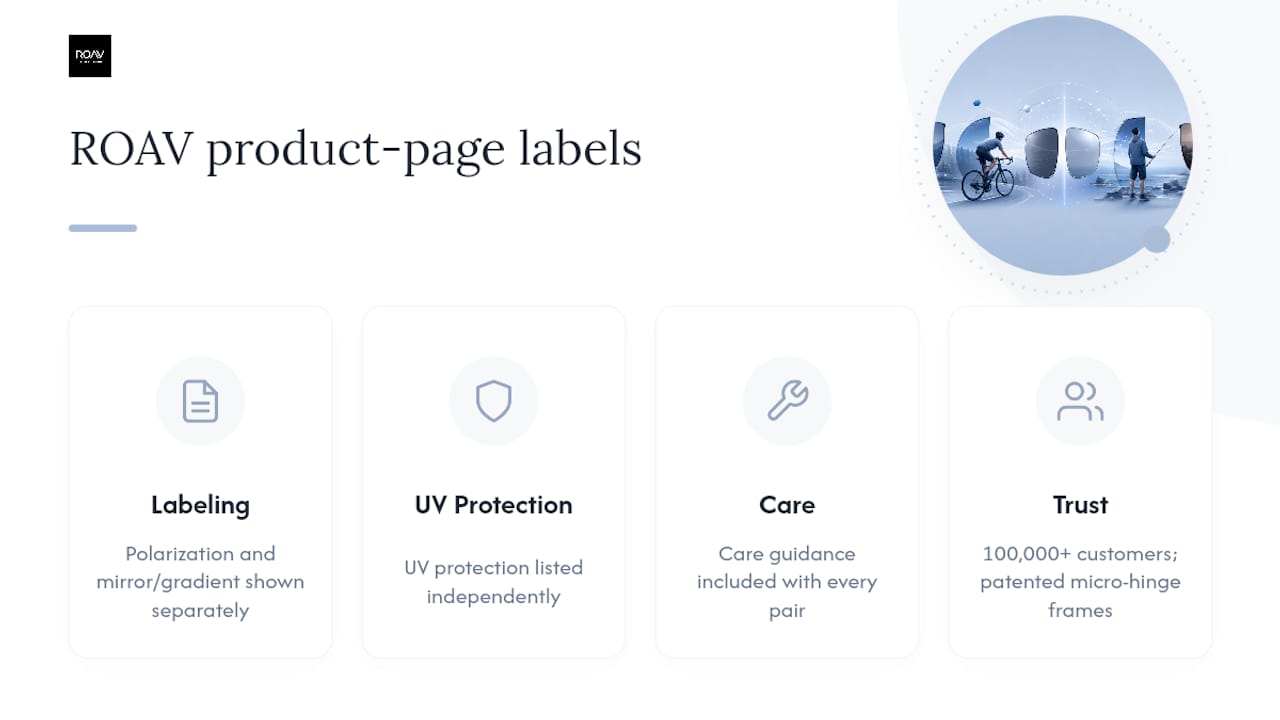
Thomas, contributing author for ROAV Eyewear, writes the publisher perspective for this piece. ROAV Eyewear built its reputation on patented micro hinge folding frames, now trusted by more than 100,000 customers who wanted eyewear that packs down without sacrificing protection.
Every ROAV product page lists polarization and mirror or gradient finish as separate, clearly stated specs, exactly the practice this guide recommends you look for anywhere you shop. You can confirm exactly what’s polarized in the current lineup through ROAV’s own explainer on which styles are polarized. UV protection is listed independently too, and product care guidance for gradient and mirror coatings ships with every pair.
Why the “just get mirrored, they look cool” advice falls short
Most buying advice treats mirrored and polarized as a style-versus-substance choice, and that framing undersells both features. Mirroring is a legitimate brightness tool, not just an aesthetic add-on, and polarization is a legitimate glare filter, not a marketing sticker. Treating either one as optional flair means you end up solving the wrong problem.
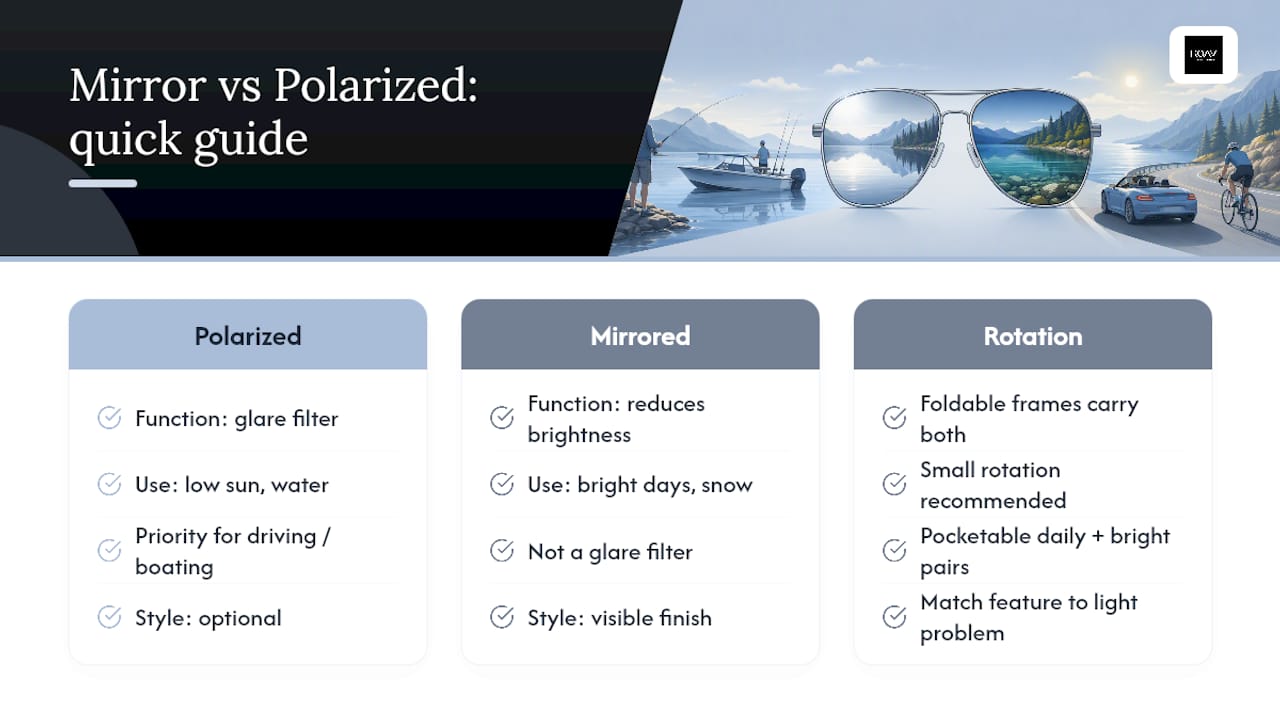
The bigger mistake I see is buyers assuming a mirrored finish covers glare because it “looks” reflective. It doesn’t work that way. If you drive into low sun or spend weekends on the water, you need the polarizing filter first, full stop. Mirror can come along for the ride if you also want a brighter day dialed down, particularly on snow.
What the research actually supports is a hierarchy: match the lens feature to the light problem, then layer style on top. Foldable frames make that decision easier in practice, since you can carry a polarized daily pair and a mirrored bright-day pair in the same jacket pocket without either one taking up real estate. That’s a genuinely underrated reason to build a small rotation instead of committing to one lens for everything.
— Thomas
Foldable styles built around this exact checklist
Once you know whether you’re chasing glare control or brightness reduction, matching a pair gets simple. ROAV Eyewear’s foldable frames carry the same UV protection and lens clarity across the lineup, so the decision comes down to tint and finish, not compromise.
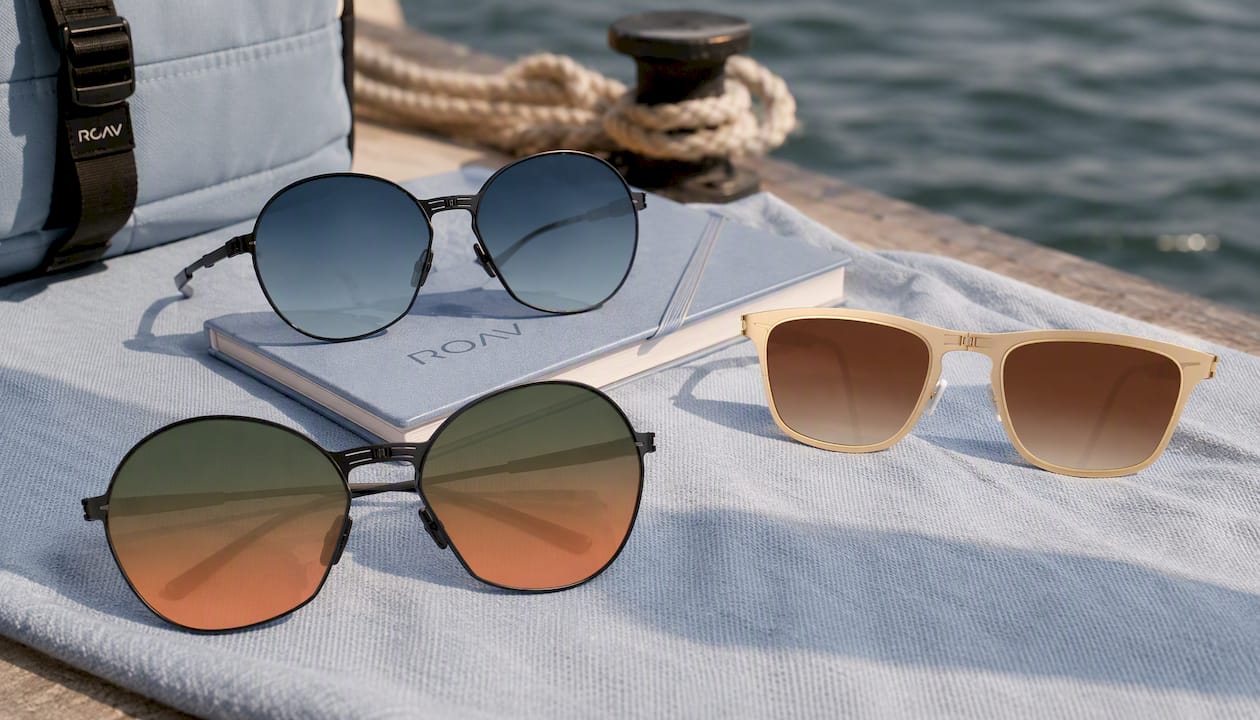
The INGRID Black | Blue-Gradient pairs a gradient tint with a reflective blue finish, a solid pick if you want a brightness-cutting look for driving or everyday glare without going full mirror. For a warmer tone that still handles harsh midday sun, the INGRID Black | Orange-Gradient delivers the same frame with a different personality. If you want something closer to a classic tint for boating or fishing days where cutting reflected glare matters most, the FRANKLIN Gold | Brown-Gradient leans into that warmer, glare-cutting brown base.
Every style folds down with ROAV’s patented micro hinge design, so you’re not choosing between the right lens and a bulky case taking up your bag. Check each product page for UV rating and lens details, then order the pair that matches the glare problem you actually have.
Sources
- Mirrored vs. Polarized Sunglasses Explained – ZENOTTIC Eyewear
- Polarized vs Mirrored vs Photochromic: Picking Sunglass Lenses for Driving, Sports, and Snow – LensDirect Blog
- Polarised vs. mirrored sunglasses: Which to choose? | Lentiamo