

The categories worth ordering first are tech essentials, comfort kits, packing organisers, drinkware, and travel bags, plus a curated multi-item kit for higher tiers. Each earns its place because people reuse it on every trip, which means repeated brand exposure at airports and hotels rather than one glance before it’s binned. If physical inventory feels like too much to manage right now, a flexible option like a gift card fills the gap without a warehouse.
TL;DR:
- Tech essentials like power banks must meet capacity and safety standards, with a physical sample recommended before mass production.
- Comfort items such as neck pillows need durable fills and washable covers to ensure they survive multiple trips and remain usable.
- Organisers should include water-resistant zippers and RFID-blocking features to maximize utility and longevity with continuous use.
- Reusable drinkware benefits from insulation, sustainable materials, and appropriate lids, with corporate prices generally ranging from $10 to $30 each.
- Curated travel kits should be assembled in branded boxes, tailored to tiers, and ordered in small batches to ensure quality and flexibility.
Table of Contents
- What are the best travel swag ideas for corporate gifting?
- Tech essentials: power banks, cables, and adapters
- Comfort and sleep items that survive repeated trips
- Organisers that reduce travel friction: toiletry kits, tech pouches, luggage tags
- Drinkware and reusable containers worth the unit cost
- Bags and luggage: matching the bag to the role
- Building curated kits and setting your gifting tiers
- What to check before you approve a production run
- Choosing sustainable materials that still hold up
- Why foldable travel eyewear earns a spot in higher-tier kits
- Legal and regulatory considerations for promotional travel swag
- A four-point rule for choosing travel swag that actually gets used
- A flexible alternative: the ROAV gift card
- Sources
What are the best travel swag ideas for corporate gifting?
Start with the categories that solve an actual travel problem, not the ones that look good in a catalogue.
- Tech essentials — power banks and multi-cables solve the one thing every traveller runs out of: battery.
- Comfort and sleep items — neck pillows and eye masks turn a red-eye flight into a small, branded relief.
- Packing organisers — toiletry kits and luggage tags reduce friction at security and baggage claim.
- Drinkware — insulated bottles get refilled often, which means frequent logo exposure.
- Bags — carry-ons and duffels can serve as the “hero” item for executives or top clients.
- Curated kits — bundling three to five items into one box works well for onboarding or conference swag.
Conferences favour drinkware and organisers because attendees carry them room to room. Frequent flyers respond best to tech and comfort. Executives often expect a bag or a premium kit, not a loose accessory.
Tech essentials: power banks, cables, and adapters
Power banks remain the single most requested travel item, and for good reason: dead phones are a universal problem. But procurement mistakes here cause the most returns and complaints, so specs matter more than they do for almost any other category on this list.
- Require a stated battery capacity and confirm it carries a recognized safety certification.
- Check USB-C, Lightning, and MagSafe compatibility separately. A cable that only serves one ecosystem alienates a third of any office.
- Confirm Power Delivery (PD) support if you want the bank to charge laptops, not just phones.
- Flag airline carry-on restrictions for lithium battery capacity before you commit to a bulk order.
- Decoration on tech items usually means laser engraving on the metal body or a printed wrap panel; expect prices to vary widely depending on capacity and finish.
Pro Tip: Order one physical sample before approving a production run. Screen renders never show you how a laser engraving actually reads against a matte aluminum finish, and that’s the detail clients notice first.
Comfort and sleep items that survive repeated trips
A neck pillow that flattens after two flights gets left in a hotel drawer. Foam density and fabric quality decide whether a comfort item becomes a repeat-use object or a one-trip throwaway, and that distinction is where most gifting budgets get wasted.
- Choose memory foam or microbead fill over basic polyester stuffing; it holds shape through repeated compression in a carry-on.
- Pick machine-washable covers. Items that can’t be cleaned often get discarded quickly, no matter how nice the branding looked at unboxing.
- Package comfort items in a compression pouch, not a rigid box, to save luggage space.
- Keep branding subtle, like a small woven label or tonal print rather than a loud logo. Professional recipients tend to keep understated items longer.
Organisers that reduce travel friction: toiletry kits, tech pouches, luggage tags
Organisers are the quiet workhorses of a travel gifting programme. Nobody gets excited unwrapping a toiletry bag, but almost everyone still uses one on every trip, which is exactly the kind of repeated exposure a curated travel gift set is built around.
- Hanging toiletry bags suit frequent flyers who live out of hotel bathrooms; tech organisers suit anyone juggling cables and dongles.
- Look for water-resistant zippers on toiletry kits and RFID-blocking lining on passport holders and card wallets.
- Luggage tags with a QR code or a simple contact insert add real utility beyond the logo.
- Pair a small organiser with a bag as a two-piece set. It reads as more considered than either item alone.
Drinkware and reusable containers worth the unit cost
Insulated tumblers and collapsible bottles get picked up more often than almost anything else on a desk, largely because thirst is a daily occurrence and a branded logo sits at eye level every time.
- Vacuum-insulated stainless steel holds temperature for hours; double-check lid type, since a straw lid suits desk use while a flip lid suits transit.
- Hand washing is often required for insulated units, so mention the care instructions in the gift note or packaging insert.
- Recycled stainless and BPA-free collapsible silicone are the two sustainable options procurement teams ask for most often.
- Laser engraving and pad printing both work on metal drinkware; screen printing suits collapsible bottles better.
- Typical corporate pricing runs $10 to $30 per unit depending on insulation quality, with MOQs often starting around 50 to 100 units.
Bags and luggage: matching the bag to the role
A carry-on says something different than a duffel, and a duffel says something different than a branded pouch. Matching the bag to the recipient’s role avoids the awkward mismatch of handing a field technician the same sleek weekender you gave the VP.
- Sales and field teams do better with rugged duffels or backpacks built for daily abuse, not delicate finishes.
- Executives and top-tier clients respond to a structured carry-on or a leather-look weekender that reads as a genuine gift, not swag.
- Check stitching at stress points (handles, zipper pulls) and confirm whether the supplier backs the bag with any workmanship warranty.
- Embroidery on fabric bags looks more premium than screen printing and holds up far longer under repeated handling.
Building curated kits and setting your gifting tiers
Standardizing around three kit tiers, conference, frequent traveller, and executive, cuts procurement complexity and lets you negotiate larger pooled production runs instead of ordering five categories separately from five suppliers.
- Conference kit: drinkware, a luggage tag, and a small tech organiser.
- Frequent traveller kit: a power bank, a comfort item, and a toiletry organiser.
- Executive kit: a premium bag, foldable eyewear, and a personalized card or note.
Ship kits pre-assembled in a branded box rather than loose items in a bag; unboxing quality drives perceived value more than most buyers expect. Stagger rollouts by tier rather than ordering everything at once, especially if you’re testing a new supplier for the first time.
What to check before you approve a production run
Imprint method depends heavily on material. Embroidery works best on fabric bags and comfort items, laser engraving suits metal drinkware and tech accessories, and screen printing remains the most economical choice for silicone or plastic components.
- Request a physical pre-production sample or a colour-matched proof, not just a digital mockup, before signing off.
- Ask every supplier for lead time, minimum order quantity, and a safety data sheet for anything electronic or battery-powered.
- Check third-party review signals, such as Trustpilot listings for promotional-goods suppliers, before committing to a first-time vendor.
Pro Tip: Ask for the supplier’s rush production timeline even if you don’t need it. A vendor who can’t quote a rush option honestly usually can’t hit a standard deadline reliably either.
Choosing sustainable materials that still hold up
Buyers are shifting toward higher-quality, sustainably made travel merchandise instead of disposable giveaways, partly because recycled materials now perform close to virgin equivalents in durability.
- RPET fabric (recycled plastic bottles) works well for bags and pouches without sacrificing strength.
- Recycled stainless steel suits drinkware and holds insulation performance identically to virgin steel.
- Ask suppliers for a material composition sheet rather than accepting a vague “eco-friendly” label at face value.
- Sustainable materials sometimes limit decoration options. Confirm embroidery or laser engraving compatibility before finalizing a design.
Why foldable travel eyewear earns a spot in higher-tier kits
Eyewear rarely makes a standard swag list, but it solves a genuine travel problem: bulky sunglasses that don’t survive a carry-on. ROAV Eyewear builds its frames around a patented micro hinge that folds down to a fraction of standard sunglasses size, backed by over 100,000 customers who’ve made it a daily-carry item rather than a drawer item. That combination of UV protection, compact storage, and repeated use is exactly what an executive travel gift needs. Pair it with a bag or a premium kit tier, not a basic conference giveaway; it reads as a considered gift rather than filler.
Legal and regulatory considerations for promotional travel swag
Anything with a battery, a blade, or a liquid needs a screening check before it ships out to employees who’ll carry it through airport security. Power banks are the biggest risk category: Transport Canada and most international carriers restrict lithium battery capacity in carry-on baggage, and a bank above roughly 100Wh typically needs airline approval or gets rejected outright at the gate. Confirm the exact watt-hour rating printed on the unit, not just the milliamp-hour figure, since that’s what screening staff actually check.
Multi-tools, branded pocket knives, and anything with a blade longer than a few centimetres will get confiscated at most security checkpoints worldwide, so they belong in checked-luggage-only gifting, if at all. Liquid-based comfort items (aromatherapy sprays, travel-size toiletries) need to respect the standard carry-on liquid limits most jurisdictions enforce, generally 100 mL per container.
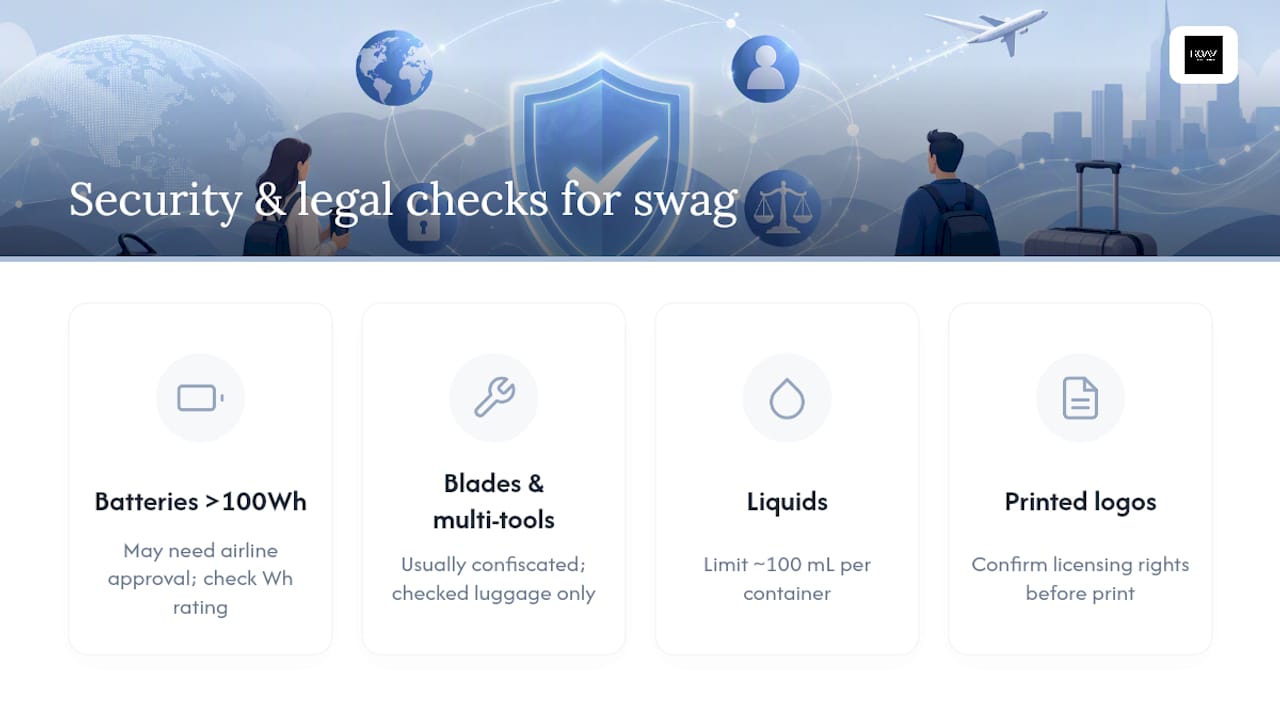
Beyond security screening, trademark and licensing rules apply the moment you’re printing a third-party logo, a licensed character, or a co-branded design alongside your own. Confirm you hold the rights to any imagery before it goes to print, since a supplier printing on your behalf typically won’t verify this for you.
Finally, if gifts go to clients rather than employees, check your own company’s gift-value policy and any relevant anti-bribery guidelines before setting a per-recipient budget, particularly for public-sector or regulated-industry clients where gift limits are often written into procurement policy.
A four-point rule for choosing travel swag that actually gets used
Run every item through four checks before you approve it: does it solve a real travel problem, will it survive twenty uses, does the branding look intentional rather than slapped on, and can your supplier actually hit the delivery date. Skip any item that fails two or more. Order five to ten samples before committing to a full production run. The catalogue photo never tells you how a zipper feels after a week of daily use, and that’s the detail recipients notice first.
— Thomas
A flexible alternative: the ROAV gift card
Sometimes the smartest travel swag decision is skipping the inventory problem entirely. A ROAV gift card works as a standalone client gift, a top-up for an executive kit, or the flexible option when you’re not sure what size or style someone prefers.
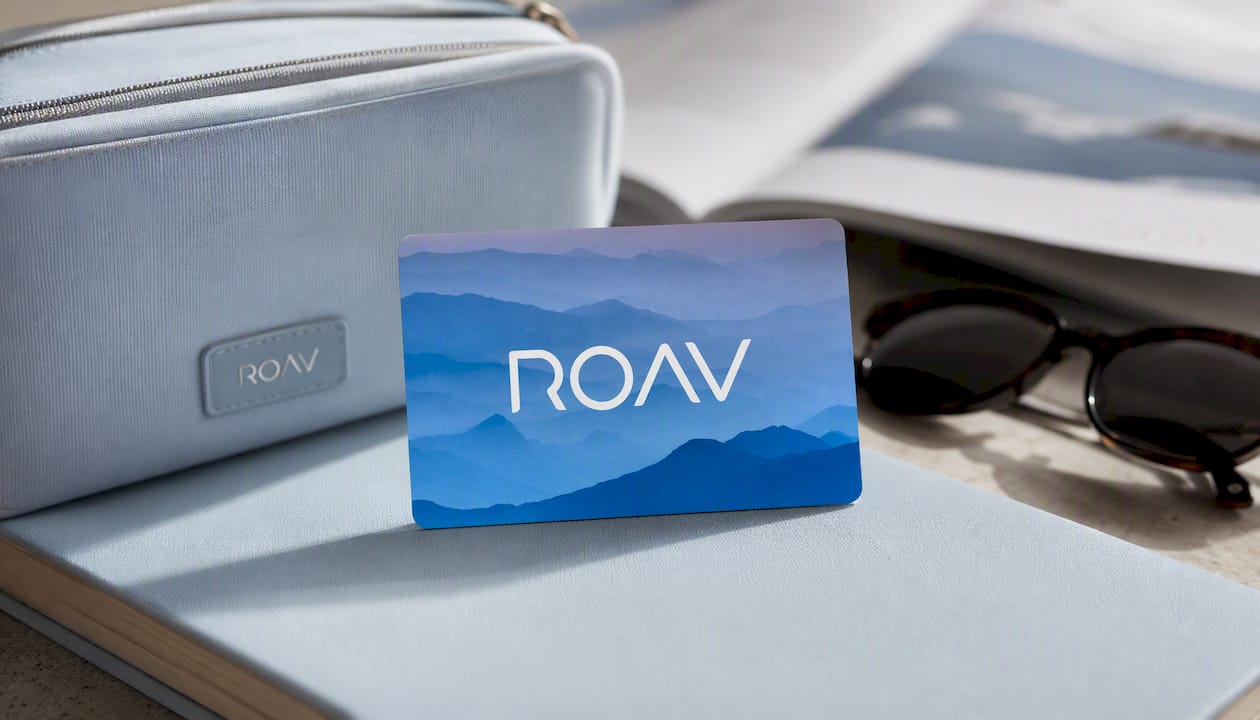
Gift cards solve the sizing and preference guesswork that comes with eyewear specifically. Rather than guessing frame style for fifty employees, you hand each one a card and let them pick foldable sunglasses or prescription frames that actually fit their face and their travel habits. For presentation, tuck the card inside a branded sleeve or pair it with a smaller item like a luggage tag so it doesn’t feel like an afterthought in a gift box. Redemption happens directly on the ROAV Eyewear site, with no extra codes or restrictions to explain in your gifting memo. If you’re building an executive or client tier and want something that feels considered without the production lead time of custom merchandise, start with the gift card product page and check current denominations before your next order deadline.
Sources
- Eco-Friendly custom printed promotional products - Best sustainable travel merchandise & corporate gifts for 2026
- Travelers corporate gift set — Swago